Paying for property in Cuba now follows one plain rule: no cash. Under Cuba’s new Housing Law, Ley 187/2026, in force since 21 October 2026, the agreed price moves through a bank instrument or another non-cash method, and the deed is signed before a notary in the province where the home stands. Cuba Luxury Rent has read the rule in the Gaceta.
In 25+ years of working in Cuba, the first question we hear from a family abroad is rarely the price. It’s the money. How it gets there, when it changes hands, and who checks that the house is really the seller’s to sell. The new law answers most of that in two short articles, and it answers it better than the old one did.
This piece walks through those two articles, the tax rule that sits next to them, and what they mean for a buyer who isn’t in Havana. It’s market information as of October 2026, written from the text of the Gaceta Oficial No. 86 of 14 October 2026. It isn’t legal advice.
What does Ley 187 say about paying for property in Cuba?
Article 90.1 of Ley 187/2026 says the agreed price in a sale is paid through the instruments or credit titles provided for in banking law, or any other method of payment that is not cash. That’s the whole rule. One sentence, published on 14 October 2026, in force a week later.
Read it slowly and two things stand out. First, the law names the bank as the normal channel, but it doesn’t lock the parties into a single instrument: a transfer, a bank cheque or another credit title all fit, as long as the money isn’t handed over in notes. Second, the rule belongs to the sale itself. It isn’t a tax form or a later formality. Paying for property in Cuba in cash is simply outside what Article 90.1 describes.
The Housing Law it replaces, Ley 65 of 23 December 1988, is repealed by the Fifth Final Provision of Ley 187, together with eight decree-laws that amended it over the years. Anything you read about Cuban property written before 21 October 2026 quotes the old text. Check the date before you trust it.
What must the seller prove before the money moves?
Before the sale, Article 90.2 of Ley 187/2026 asks the seller for three things: proof that any debt on the home’s own purchase price is settled, proof that the tax has been paid, and proof that the home is recorded in the Central Property Register for Real Estate. All three come first. The buyer’s money comes after.
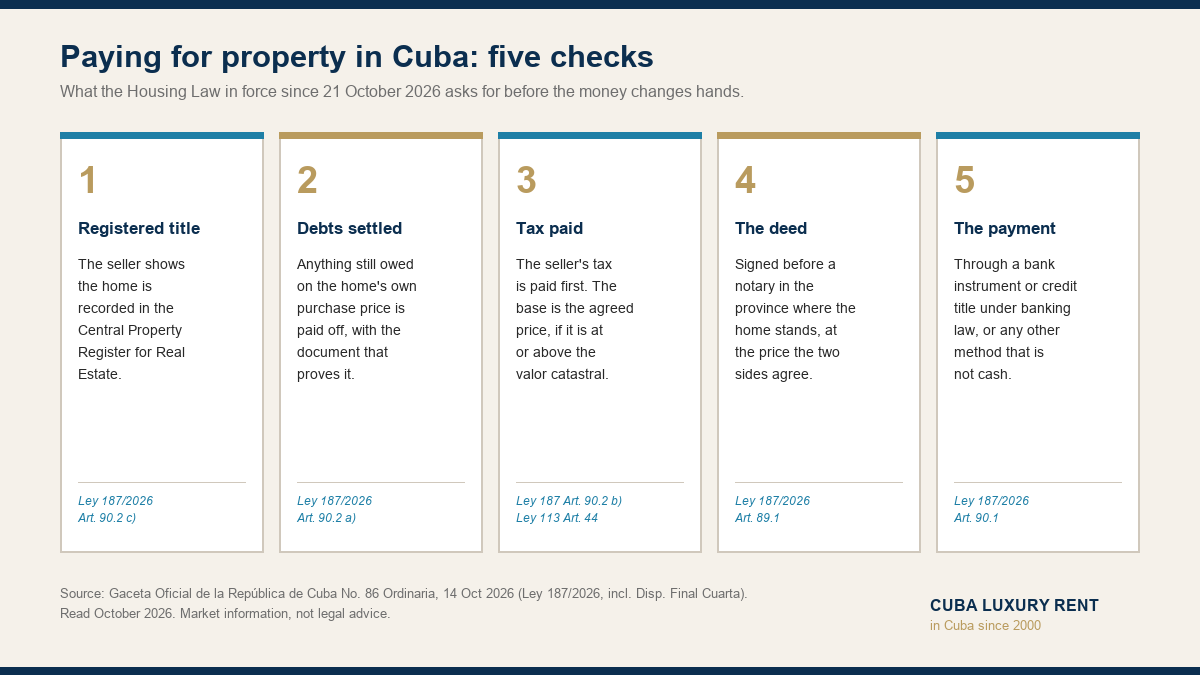
This is the part buyers abroad tend to skip, and it’s the part we’d read twice. The first check asks for a document, not a promise: whatever was still owed on the price of the home has to be shown as paid. The third check matters even more. A house that isn’t in the register can be lived in, inherited and loved for three generations, and still not be ready to sell.
None of this is new paperwork for its own sake. Each check closes a door that would otherwise stay open after the buyer has paid. Our view: if a seller can’t show the register entry on the first visit, the sale isn’t close yet, however friendly the conversation is.
Why does a non-cash rule work in the buyer’s favour?
Because it leaves a trail with three ends that match: the price written in the deed, the payment recorded by the bank, and the title entered in the register. When paying for property in Cuba runs through a bank, each of those documents can be checked against the other two, years later, by an heir, a lawyer or the next buyer.
That matters more than it sounds. A Havana house tends to stay in a family for a long time, and the people who inherit it often live in another country and never met the seller. What they’ll have is paper. The new rule makes sure the paper includes proof that the price was actually paid, and how.
It also takes one awkward conversation off the table. Nobody has to carry a sum across a city, count it in a living room, or argue later about whether it was all there. The bank keeps the record. Done.
Where is a Cuban property sale signed, and by whom?
A sale of a home is formalised before a notary, by public deed, at a notary’s office in the province where the home stands, at the price the two sides agree. That’s Article 89.1 of Ley 187/2026, and it applies to sales between people, between people and companies, and between companies.
Two details in Article 89 are easy to miss. The price is the parties’ own: the law says “the price agreed between the parties”, and the State doesn’t set it. And Article 89.2 lets buyer and seller add as many clauses and conditions as they want, as long as they aren’t contrary to the law or the social order. A staged handover, a date for vacating, who keeps the furniture. It all goes in the deed.
Notaries themselves work under a separate law, Ley 175/2024 on the notarial system, published in July 2025. Our earlier guide to the steps of a sale covers that side; this one stays with the money.
How is the tax base set when paying for property in Cuba?
For a sale, the tax base is the agreed price, provided it is equal to or above the home’s valor catastral, the official value set for tax purposes. Ley 187 rewrote Article 44 of the tax law, Ley 113/2012, to say exactly that, in its Fourth Final Provision.
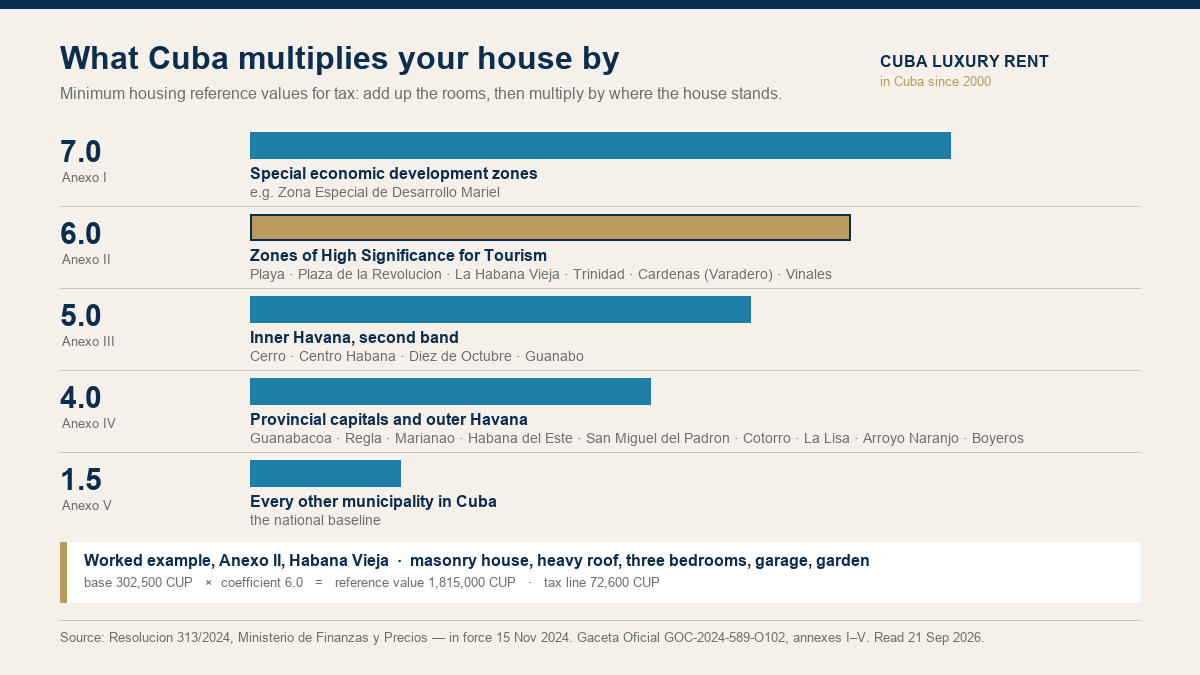
The same provision rewrote Article 203.1 of Ley 113: for any transfer of a home, the base takes into account the valor catastral set by the authority empowered to set it. For an exchange of homes with a cash difference (a permuta with compensation), Article 203.2 makes the base the valor catastral plus the compensation.
In plain terms, the valor catastral works as a floor. Writing a low price into the deed doesn’t shrink the base below it. We explained how that number is built in how Cuba values a home, and the chart of reference-value bands from that work still shows why a house in Vedado and one on the edge of the city start from different places. We don’t quote a tax rate here; that’s a figure to confirm with the notary for the specific deed.
| Step | What Ley 187/2026 asks for | Where it is written |
| Title | The home is recorded in the Central Property Register for Real Estate | Ley 187, Art. 90.2 c) |
| Earlier debts | Anything owed on the home’s own price is shown as paid | Ley 187, Art. 90.2 a) |
| Seller’s tax | Paid before the sale | Ley 187, Art. 90.2 b) |
| Tax base | The agreed price, if equal to or above the valor catastral | Ley 113, Art. 44 (rewritten by Ley 187, Disp. Final Cuarta) |
| Deed | Public deed before a notary in the province where the home stands, at the agreed price | Ley 187, Art. 89.1 |
| Clauses | Any pacts and conditions not contrary to law or social order | Ley 187, Art. 89.2 |
| Payment | Bank instruments or credit titles under banking law, or any other non-cash method | Ley 187, Art. 90.1 |
Paying for property in Cuba under Ley 187/2026, in the order the law asks for it. Source: Gaceta Oficial No. 86 Ordinaria, 14 October 2026; in force 21 October 2026.
What changed on 21 October 2026, and what stayed?
What changed is the law itself. Ley 187/2026 was published on 14 October 2026 and, under its Sixth Final Provision, took effect seven days after publication. The Fifth Final Provision repeals Ley 65 of 1988 and eight decree-laws that amended it between 1998 and 2018.
What stayed is the shape of a sale. A notary, a public deed, a register entry, a tax tied to an official value. Anyone who bought or sold a Havana home in the last ten years will recognise the sequence. The difference is that the payment rule now sits in one clear article, inside the Housing Law, and that the tax base is written against the valor catastral by name.
One honest caveat. A law in force for a week has no practice around it yet. Notaries will read Article 90.1 the way their instructions tell them to, and those instructions aren’t public. We’ll update this piece when they are.
What does this mean for a buyer living abroad?
For a buyer outside Cuba, paying for property in Cuba means the price has to reach the seller through a payment method that isn’t cash, and the notary has to be satisfied with it on the day of the deed. The law doesn’t say which bank, which country or which currency. That gap is deliberate, and it’s where the planning happens.
Three things we’d sort out before booking a flight. Ask the seller for the register entry and the proof that the home’s own price is settled; if either is missing, the sale can’t close, however good the house is. Ask your own bank how it handles a payment into Cuba from where you live, because the answer depends on your bank and your country, not on Cuban law. And ask a Cuban lawyer to read the draft deed, clauses included, before anyone signs.
Then plan the visit around the notary, not the other way round. The deed is signed in the province where the house is. For Old Havana, Vedado or Miramar, that’s Havana.
How does Cuba Luxury Rent help with a sale in Havana?
Cuba Luxury Rent lists homes for sale in Havana and works with the owners behind them, with the paperwork on the table early. Our homes for sale in Cuba page shows what’s open now, including Maison Habana Vieja, a restored colonial house in Old Havana. The payment itself runs between buyer and seller, through the bank, before a notary, as Article 90 says.
What we bring is the part a law can’t: 25+ years in Cuba, since 2000, a network in Havana, and the habit of asking for the register entry before anyone talks about furniture. If you’re weighing a purchase, tell us what you’re looking for and we’ll start with the documents.
Frequently asked questions
Can you pay for a house in Cuba in cash?
No. Article 90.1 of Cuba’s Housing Law, Ley 187/2026, in force since 21 October 2026, says the agreed price in a sale is paid through bank instruments or credit titles under banking law, or any other method of payment that is not cash. A cash payment falls outside what the law describes.
What does a seller have to prove before a Cuban home sale?
Under Article 90.2 of Ley 187/2026, the seller must first show three things: that any debt on the home’s own purchase price is settled, that the tax has been paid, and that the home is recorded in Cuba’s Central Property Register for Real Estate. All three come before the buyer’s money moves.
Where is a property sale in Cuba signed?
Before a notary, by public deed, at a notary’s office in the province where the home stands. Article 89.1 of Ley 187/2026 sets this rule for sales between individuals, between individuals and companies, and between companies. The price is the one the two parties agree, and they may add lawful clauses.
What is the tax base when a home is sold in Cuba?
The agreed sale price, provided it is equal to or above the home’s valor catastral. Ley 187/2026 rewrote Article 44 of the tax law, Ley 113/2012, to say so, and Article 203.1 now ties the base for any home transfer to the valor catastral set by the competent authority.
Which law governed Cuban home sales before October 2026?
Ley 65, the General Housing Law of 23 December 1988, with eight amending decree-laws between 1998 and 2018. Ley 187/2026 repealed all of them in its Fifth Final Provision. It was published in Gaceta Oficial No. 86 on 14 October 2026 and took effect seven days later.
Nothing in this article is legal advice. Cuba Luxury Rent describes the published law as of October 2026; for a specific purchase, check with a Cuban lawyer or notary.



Join The Discussion