Cuba taxes a home sale on the transaction price, as long as that price sits at or above a state minimum. Two separate systems produce that minimum: the valor referencial, a five-zone table set by Resolucion 313/2024, and the valor catastral Cuba, built on a module of 13 Cuban pesos per square metre fixed by Resolucion 284/2022.
Thirteen pesos. Per square metre. On 17 August 2026, elTOQUE put the informal market at 665 CUP to the US dollar, and CADECA – the state exchange house – was buying dollars at 585. At either rate, 13 pesos is about two US cents.
That figure isn’t a typo and it isn’t a scandal. It’s a base unit inside a formula, with coefficients applied on top. But it matters more this year than last, because the Housing Law approved on 30 July 2026 moves the tax base onto exactly that system.
What is the valor referencial, and who pays what?
The valor referencial is a minimum taxable value for a home sale or donation between individuals. Resolucion 313/2024 of Cuba’s Ministerio de Finanzas y Precios – Gaceta Oficial No. 102 Ordinaria de 2024, identifier GOC-2024-589-O102, in force from 15 November 2024 – sorts homes into five zones by typology and location and attaches a minimum value to each.
The tax sits on both sides of the table. The buyer pays 4% Impuesto sobre Transmision de Bienes y Herencias; the seller pays 4% Impuesto sobre los Ingresos Personales Eventuales, rising to 8% on a second or later sale inside the same fiscal year. Those rates come from the ministry’s own published Q&A on the resolution.
The ministry’s stated reasoning is the interesting part. The values it replaced had been in force since 2017. Studies, it wrote, showed actual sale prices running ten times higher than the minimums used for tax. So it raised the minimums by five.
Five, against a gap it had just measured at ten. That’s a deliberate half-step, and I’d read it as a revenue decision rather than a valuation one – move the floor enough to collect more, not enough to make declaring the real price feel safe. Municipal councils can cut the minimum by a further 10% for suburban property. Location coefficients do the rest of the work: the ministry’s worked examples put Marianao in Havana at 4.0 and Majibacoa in Las Tunas at 1.5.
One detail if you’re reading the norm itself: the text needed fixing. A corrected version was republished as GOC-2025-111-ES5 in Gaceta Oficial Edicion Especial No. 5 of 19 March 2025, four months after the resolution took effect.
What is the valor catastral cuba, and where does it come from?
The valor catastral is the cadastre’s own figure for a property. Decreto-Ley 332/2015 and its regulation, Decreto 331/2015 – both in Gaceta Oficial No. 37 Extraordinaria de 2015 – set how the Catastro Nacional is organised and run. Decreto 13/2020, Gaceta Oficial No. 81 Ordinaria de 2020, amended the regulation and carries the valuation parameters used today.
The chain of norms behind the number is short, and reading it in order explains a lot. Instruccion 24/2001 of the Ministerio de Finanzas y Precios fixed the value module at 10.00 pesos per square metre – for the year 2001. Resolucion 18/2001 enacted the methodology for determining cadastral value of urban property. That methodology is now repealed: Resolucion 284/2022, Gaceta Oficial No. 116 Ordinaria de 2022, replaced it and fixed the module at 13 Cuban pesos per square metre, for urban land and construction and for rural property alike.
The institutional side moved too. Decreto-Ley 42/2021, Gaceta Oficial No. 96 Ordinaria de 2021, reorganised the physical planning system and created the Instituto Nacional de Ordenamiento Territorial y Urbanismo. The cadastre department sits inside that system at municipal level, and the GEOCUBA business group runs the field survey the municipal office then qualifies. So the machinery exists: a law, a regulation, a surveying company, an office, a certificate you can request.
Why does a 13-peso module matter this much?
Because it’s the base unit the rest of the calculation multiplies. Ten pesos per square metre in 2001, thirteen in 2022 – a 30% rise across 21 years. Over the same stretch the peso lost most of its purchasing power against hard currency, and the tax minimums in the parallel referential system were multiplied by five in a single 2024 resolution.
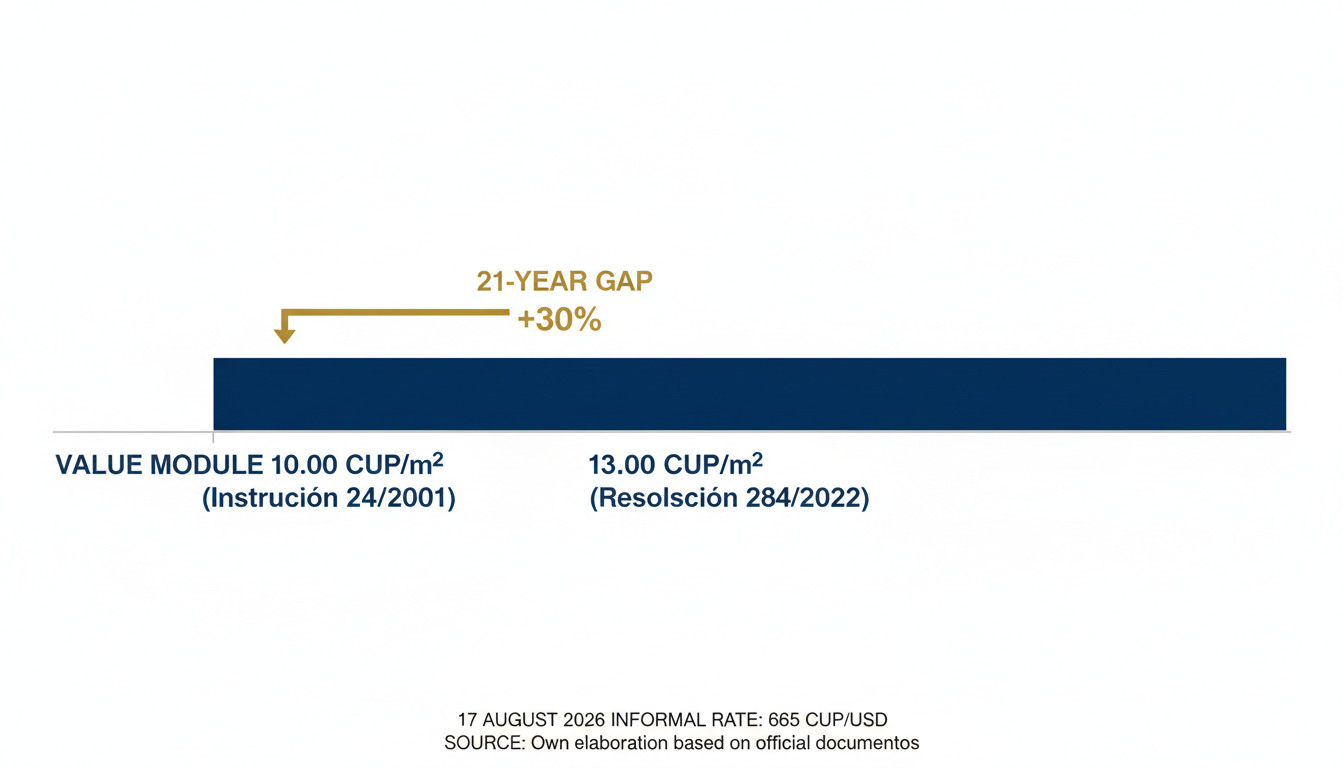
Coefficients sit on top, so 13 pesos per square metre is not what a Havana apartment is deemed to be worth. Nobody should read it that way. What it does mean is that the anchor of the cadastral calculation is a peso amount set once in 2022 and unchanged since. An anchor that moves 30% in two decades can’t track a market that reprices monthly.
An honest limit on what Cuba Luxury Rent can verify: we could not retrieve the full current coefficient tables. Resolucion 18/2001 carried the old methodology and is repealed; what the portal publishes as its successor is the resolution fixing the module, while the valuation parameters sit in Decreto 331/2015 as amended by Decreto 13/2020. For the exact arithmetic on a specific property, ask a Cuban lawyer and the municipal cadastre office that issues the certificate.
What does the new Housing Law change about the tax base?
It moves the base onto the valor catastral. The June 2026 draft is explicit. Article 144: “La base imponible del impuesto sobre la propiedad y actos de transmision de la vivienda, esta constituida por el valor catastral.” Disposicion Final Quinta rewrites Article 44 of Ley 113, the tax code, around the same concept.
Quoted in full, because the wording carries the whole mechanism. The draft’s new Article 44 of Ley 113 reads: “Para los actos de compraventa de vivienda, la base imponible esta constituida por el precio de transferencia de la vivienda que se transmite, siempre que resulte igual o superior al valor catastral.” The transfer price is the base, floored by the cadastral value. The new Article 203 adds that the figure used is “el valor catastral dictaminado por la autoridad facultada para ello”.
Which body? The draft doesn’t name it. That’s left to the regulations. Article 34 applies the same standard elsewhere: the price of a home from the built patrimony assigned by a Municipal Administration Council is set in line with the cadastral value of urban and rural real property.
Two cautions, and I’d rather over-state them than get this wrong. Every quote here is from the PROYECTO – the June 2026 draft published by the Asamblea Nacional, 92 pages, which Cuba Luxury Rent read in full. The text approved on 30 July 2026 has not been published, so nobody outside the process can confirm the final wording. And what happens to Resolucion 313/2024 once the new law is running belongs to the implementing regulations and to a Cuban lawyer. Cuba Luxury Rent isn’t going to guess at it in public.
Has the new Housing Law actually taken effect yet?
No. The Asamblea Nacional del Poder Popular approved it on 30 July 2026. Disposicion Final Octava of the draft sets entry into force at 90 days after publication in the Gaceta Oficial. As of 17 August 2026 it hadn’t appeared: the newest edition on gacetaoficial.gob.cu is Edicion Especial No. 10, dated 10 August 2026.
The clock hasn’t started. That’s worth saying plainly, because plenty of coverage in July and August described the law as though it were already operating.
There’s a scheduling quirk in the draft worth watching. Disposicion Final Primera gives the Council of Ministers 60 days from approval to issue the regulations – so end of September 2026. The law itself starts 90 days after a publication that hasn’t happened. On the draft’s own timetable, the regulations could be written before the law they regulate is in force.
For scale on what’s being replaced: Disposicion Final Septima repeals Ley 65, the General Housing Law of 23 December 1988, plus eight decree-laws that amended it between 1998 and 2018. Nine instruments, one replacement.
Two valuation systems, side by side (as of August 2026)
| Criterion | Valor referencial | Valor catastral |
| Governing norm | Resolucion 313/2024 MFP (GOC-2024-589-O102) | Decreto-Ley 332/2015 + Decreto 331/2015, amended by Decreto 13/2020 |
| Where published | Gaceta Oficial No. 102 Ordinaria de 2024; corrected text in Ed. Especial No. 5, 19 Mar 2025 | Gaceta Oficial No. 37 Extraordinaria de 2015; Gaceta No. 81 Ordinaria de 2020 |
| Base unit | Zone table – five zones by typology and location | 13.00 CUP per square metre (Resolucion 284/2022, Gaceta No. 116 Ordinaria de 2022) |
| Previous base unit | Values in force since 2017, multiplied by 5 in 2024 | 10.00 CUP per square metre for 2001 (Instruccion 24/2001 MFP) |
| Example coefficients | Marianao, Havana 4.0; Majibacoa, Las Tunas 1.5 (MFP published Q&A) | Parameters in Decreto 331/2015 as amended; full tables not retrievable on the portal |
| Who applies it | ONAT, at the notarial act | Municipal cadastre office in the planning system; GEOCUBA executes the survey |
| Tax rates attached | 4% buyer (Transmision de Bienes y Herencias) + 4% seller (Ingresos Personales Eventuales); 8% on a second sale in the same fiscal year | Same tax code, Ley 113 of 23 July 2012 |
| Status in the new Housing Law | Not named in the draft’s text | Named as the tax base in Article 144 and in the rewritten Articles 44 and 203 of Ley 113 (PROYECTO) |
Sources for the table: gacetaoficial.gob.cu norm records and mfp.gob.cu, all retrieved 17 August 2026; PROYECTO Ley de la Vivienda, parlamentocubano.gob.cu, June 2026.
What would a working Cuban property cadastre require?
Four things, and Cuba has two of them. It has the legal architecture – Decreto-Ley 332/2015 and a Catastro Nacional with municipal offices – and it has survey capability in GEOCUBA. What isn’t on the public record is a value module that moves with the currency, and a valuation authority named in the law rather than deferred to regulations.
Coverage is the fourth, and the oldest problem of the set. In November 2011, EFE reported from Granma that just over 200,000 homes had been registered since the government opened title inscription in 2003 – about 6% of individually-owned property, against an Instituto Nacional de la Vivienda stock of 3.7 million. That’s a 2011 figure. Cuba Luxury Rent could not verify a newer official one, and I’d treat anyone quoting a current percentage with suspicion until they name the publication.
The register also drifts, because building outruns paperwork. Cuba finished 16,065 homes in 2023, the lowest in five years and 36% of the 44,566 completed in 2019, per the ONEI statistical yearbook published in July 2024. Most of that total – 9,860 homes – came from the population and non-state entities rather than the state. Owner-built housing, added room by room, in a country where the deficit passed 850,000 homes by official accounts in July 2024. Every addition is a square metre a cadastre has to find before it can value it.
That’s the real work behind the phrase valor catastral: not a formula, a survey. Somebody has to measure it.
What does this mean if you’re buying or inheriting in Cuba?
Work on documents, not estimates. Get the escritura and confirm the property’s registration status at the Registro de la Propiedad. Request the cadastral certification early, because it’s the figure the tax calculation will lean on. Expect the taxable base to be the transfer price, floored by a state value. And put a Cuban lawyer on it before you sign anything.
Three practical notes from what’s actually published. Donations between relatives up to the fourth degree of consanguinity don’t use the referential minimums at all – the ministry’s Q&A says those use the property’s updated appraised value. Selling twice in one fiscal year carries 8% rather than 4% on the seller’s side, so the calendar matters. And check whether your copy of the norm is the original or the March 2025 correction.
The wider point for anyone watching this market from outside: the movement right now is in valuation plumbing, not in prices. A tax base shifting from a five-zone reference table to a cadastral figure decides how transparent transactions can be a decade from now, and it’ll be settled in regulations most people won’t read.
Cuba Luxury Rent has been working in Cuba since 2000, with an office in Havana, and reads these norms in the Gaceta as they appear rather than through summaries. This piece was written from the primary texts on 17 August 2026, and it’ll be updated with the published article numbers and the date the 90-day clock starts.
None of this is legal advice or a substitute for a Cuban lawyer on your specific property. If you want the market read rather than the legal one – what’s moving, what’s stalled, what a given Havana district is actually doing – the concierge desk or a note through /contact/ reaches someone who’s been on the ground for a quarter of a century.
Frequently asked questions
What is the valor referencial in Cuba?
The valor referencial is the minimum value used to calculate tax on a home sale or donation between individuals in Cuba. Resolucion 313/2024 of the Ministerio de Finanzas y Precios, published in Gaceta Oficial No. 102 Ordinaria de 2024 and in force from 15 November 2024, groups homes into five zones by typology and location.
What is the valor catastral in Cuba?
The valor catastral is the cadastral value recorded for a property by Cuba’s Catastro Nacional, governed by Decreto-Ley 332/2015 and Decreto 331/2015 as amended by Decreto 13/2020. Its per-square-metre module is 13 Cuban pesos, fixed by Resolucion 284/2022 in Gaceta Oficial No. 116 Ordinaria de 2022, replacing the 10 pesos set for 2001.
What tax do you pay on a home sale in Cuba?
The buyer pays the Impuesto sobre Transmision de Bienes y Herencias at 4% and the seller pays the Impuesto sobre los Ingresos Personales Eventuales at 4%, according to the Ministerio de Finanzas y Precios. On a second or subsequent sale within the same fiscal year, the seller’s rate rises to 8%. Both are calculated on the transaction value.
Is Cuba’s new Housing Law in force?
No. The Asamblea Nacional approved it on 30 July 2026, and Disposicion Final Octava of the draft sets entry into force at 90 days after publication in the Gaceta Oficial. As of 17 August 2026 it had not been published; the newest edition on gacetaoficial.gob.cu was Edicion Especial No. 10 of 10 August 2026, so the 90-day period has not begun.
Does the new Housing Law change how Cuban homes are taxed?
The June 2026 draft moves the tax base onto the cadastral value. Article 144 states that the taxable base for property and transmission tax is the valor catastral, and Disposicion Final Quinta rewrites Article 44 of Ley 113 so the base is the transfer price provided it equals or exceeds that value. The approved text has not been published.
SOURCES
Primary – Gaceta Oficial de la Republica de Cuba (norm records, gacetaoficial.gob.cu):
- Resolucion 284 de 2022, Ministerio de Finanzas y Precios – GOC-2022-1063-O116, Gaceta Oficial No. 116 Ordinaria de 2022. Fixes the 13 CUP/m2 value module for urban land and construction and for rural property. Repeals Resolucion 18/2001.
- Resolucion 313 de 2024, Ministerio de Finanzas y Precios – GOC-2024-589-O102, Gaceta Oficial No. 102 Ordinaria de 2024. Minimum referential values. Corrected text republished as GOC-2025-111-ES5, Gaceta Oficial Edicion Especial No. 5, 19 March 2025.
- Resolucion 18 de 2001, Ministerio de Finanzas y Precios – GOC-2001-353-O21, Gaceta Oficial No. 21 Ordinaria de 2001. Methodology for determining cadastral value of urban property. Status: derogada, repealed by Resolucion 284/2022.
- Instruccion 24 de 2001, Ministerio de Finanzas y Precios – GOC-2001-533-O32. Sets the value module at 10.00 pesos per square metre for 2001.
- Decreto-Ley 332 de 2015, Consejo de Estado – Gaceta Oficial No. 37 Extraordinaria de 2015. Organisation and functioning of the Catastro Nacional. Status: modified by Decreto-Ley 42/2021.
- Decreto 331 de 2015, Consejo de Ministros – Gaceta Oficial No. 37 Extraordinaria de 2015. Regulation of the above. Status: modified by Decreto 13/2020.
- Decreto 13 de 2020, Consejo de Ministros – GOC-2020-737-O81, Gaceta Oficial No. 81 Ordinaria de 2020. Amends Decreto 331/2015; carries the valuation parameters in current use.
- Decreto-Ley 42 de 2021, Consejo de Estado – GOC-2021-802-O96, Gaceta Oficial No. 96 Ordinaria de 2021. Reorganisation of the physical planning system and creation of the Instituto Nacional de Ordenamiento Territorial y Urbanismo.
- Gaceta Oficial portal front page, checked 17 August 2026 – newest edition listed: Edicion Especial No. 10, 10 August 2026. The Housing Law is not among the published norms. The portal’s vivienda topic page, also checked 17 August 2026, does not list it either.
Primary – Asamblea Nacional del Poder Popular:
- PROYECTO LEY DE LA VIVIENDA, parlamentocubano.gob.cu, June 2026, 92 pages. Read in full and text-extracted. Articles 34, 143 and 144 quoted verbatim; Disposiciones Finales Primera, Quinta, Septima and Octava quoted verbatim. Retrieved 17 August 2026.
Primary – Ministerio de Finanzas y Precios (mfp.gob.cu):
- Noticia 892 – “Se actualizan los valores referenciales minimos de las viviendas…”. Reasoning for the update, the fivefold increase, values in force since 2017, market prices ten times above the minimums, five zones, 15 November 2024 effective date, the 10% municipal reduction for suburban property. Retrieved 17 August 2026.
- Noticia 893 – “Preguntas y Respuestas sobre los Impuestos asociados al acto de compraventa y donaciones de viviendas entre personas naturales”. The 4% / 4% / 8% rates, who pays which, the treatment of donations between relatives to the fourth degree, and the worked coefficient examples (Marianao 4.0, Majibacoa 1.5). Retrieved 17 August 2026.
Secondary – independent press:
- elTOQUE, exchange-rate page, retrieved 17 August 2026 at 09:00 Havana time. Informal market 1 USD = 665.00 CUP, 1 EUR = 770.00 CUP; formal market CADECA buying USD at 585.00 and selling at 608.40, BPA selling at 627.30.
- elTOQUE, Loraine Morales Pino, “Se necesita medio siglo para suplir el deficit habitacional en Cuba”, published 3 September 2024, updated 29 December 2024. Cited for: 16,065 homes completed in 2023 (ONEI yearbook, July 2024), 36% of the 44,566 of 2019, 9,860 built by population and non-state entities vs 6,205 state, and the deficit above 850,000 reported by official media on 16 July 2024 (Delilah Diaz Fernandez, MICONS). Article date stated in the post’s own byline – checked, not assumed. Cloudflare blocked the command-line fetch; retrieved through the browser.
- EFE via Cuba Encuentro, “Apenas un 6 % de las viviendas en Cuba estan registradas”, published 5 November 2011, citing Granma and the Instituto Nacional de la Vivienda. Used ONLY as an explicitly dated 2011 figure – just over 200,000 homes registered since 2003, about 6% of individually-owned property, stock of 3,700,000. Cloudflare blocked the command-line fetch; retrieved through the browser.



Join The Discussion