
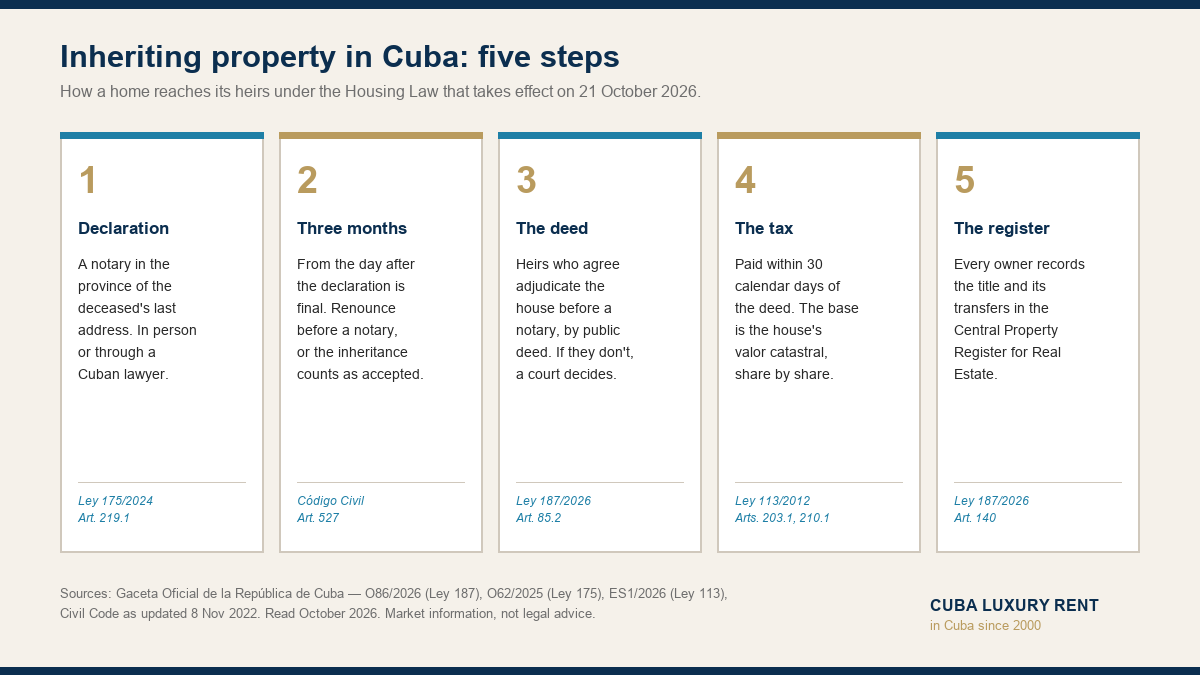
Inheriting property in Cuba runs through a notary. The heirs obtain a declaration of heirs, have three months to renounce or are taken to accept, and then adjudicate the house by public deed. From 21 October 2026, Cuba’s new Housing Law, Ley 187, governs that last step, and the tax is due within 30 days of the deed.
The call usually comes a few weeks after the funeral, from Miami or Madrid or Mexico City. A grandmother’s house in Vedado: three bedrooms, a porch, a mango tree nobody has pruned since spring. A family spread over three countries. And one question, always the same one. Is the house still ours?
The answer sits in four texts, and one of them changes next week. On 14 October 2026 Cuba published its new Housing Law in the Gaceta Oficial. It takes effect on 21 October and repeals the 1988 law that every older guide still quotes. Cuba Luxury Rent has worked with Cuban houses and the families who own them since 2000. This is inheriting property in Cuba as the texts read in October 2026, article by article.
What changes for inheriting property in Cuba on 21 October 2026?
The house now passes under Ley 187/2026. Its Article 85 sends a deceased owner’s home through the ordinary succession rules of the Civil Code, and lets heirs who agree adjudicate it before a notary by public deed. The tax base for any transfer of a home becomes its valor catastral, under the tax law as rewritten by Ley 187 itself.
Ley 187 was approved by the National Assembly on 30 July 2026 and printed in Gaceta Oficial No. 86 of 14 October 2026, together with its general regulation, Decreto 176/2026. Its sixth final provision sets entry into force seven days after publication. Its fifth repeals Ley 65 and eight decree-laws that had amended it, including Decreto-Ley 288 of 2011, the one that opened private home sales.
For a family, most of the change is venue and vocabulary. Agreement goes to a notary; disagreement goes to court (Article 85.2). If an heir renounces a house that stands empty, Article 88 sends it to the State, which pays its price to the heirs if they ask for it. Where there are no heirs at all, the State takes the house only once two years have passed since the death.
One line in the new regulation deserves a wider audience. Under Decreto 176, Article 132.4, if heirs appear at any point in that two-year process, or are already in the middle of their paperwork, the housing director closes the file and gives them back possession of the house if they want it.
Who inherits a house in Cuba when there is no will?
The children first, in equal shares. Under Article 514 of Cuba’s Civil Code, as updated by the 2022 Family Code, an estate without a will goes first to the children and other descendants, without prejudice to the surviving spouse or partner and to dependent parents unable to work. Grandchildren inherit by representation.
Article 467 allows two routes, by will or by law, and lets one estate use both. Article 522 says heirs acquire the inheritance from the moment of death, and Article 528 dates acceptance and renunciation back to that same moment. The declaration of heirs belongs to the route without a will: under the notarial law, the act records the “intestate death” of the owner. With a will, the heirs are already named in it.
How does the declaration of heirs work in Cuba?
It’s a notarial act. Under Ley 175/2024, Article 219, the competent notary sits in the province of the deceased’s last recognised address in Cuba. The heirs apply in person or through a lawyer, with the death certificate, proof of kinship and marital status, and a certificate from the Registry of Last Wills and Declarations of Heirs.
Ley 175, the notarial law, was approved on 19 December 2024 and published in Gaceta Oficial No. 62 of 7 July 2025; it has been in force since January 2026. The notary opens the file, takes witness statements and may send it to the prosecutor for an opinion (Article 221). If that opinion comes back with a condition, the family has up to 60 working days to meet it (Article 222). Within two working days of signing, the notary sends a copy to the registry, and the declaration is complete once it’s recorded there (Article 228).
For a family inheriting property in Cuba from three countries, Article 219.2 is the clause that matters. Everyone called to inherit appears, but the text lets each of them do it through a lawyer.
How long do heirs have to accept or renounce in Cuba?
Three months. Under Article 527 of the Civil Code, the window to renounce closes three months after the day the declaration of heirs becomes final, or, with a will, three months after the heir officially learns of it. Silence counts as acceptance. A renunciation must be made before a notary or the court handling the succession (Article 526).
Acceptance can be written or simply shown by conduct (Article 524). Either way, the heir answers for the estate’s debts only with what the estate contains (Article 525). Renouncing in favour of another heir is a different act from renouncing outright: under Articles 474 and 475, a share given to a named heir goes to that heir, while a share renounced without naming anyone grows the shares of the others.
Our view, after a long time watching families do this: talk about who keeps the house before the declaration is final. Three months is short when the cousins are in different time zones.
What changes for heirs abroad on 1 November 2026?
Cuba’s new Migration Law takes effect. Ley 171/2024, Article 31, says Cuban citizens resident abroad have the right to use, enjoy and freely dispose of the property they own, in line with Article 58 of the Constitution and “in accordance with the law”. It was published on 5 May 2026 and enters into force 180 days later.
The same law sorts Cubans into two categories, resident in the national territory or resident abroad (Article 26). Under Article 29, the second group covers those who live most of their time abroad, those who held the status of emigrado before the law, and investors and business people. Article 29.3 lets an emigrado apply to become a resident abroad.
One older line hasn’t moved. The Civil Code still contains Article 470, which lists having “definitively abandoned the country” as a cause of incapacity to inherit, and Article 473 asks whoever files a declaration of heirs to state under oath whether such a person exists. That phrase is older than the 2024 categories. How the two texts meet in a given family is a question for a Cuban lawyer, and we won’t answer it here.
Two tools help when the family inheriting property in Cuba lives elsewhere. Ley 175, Article 97, allows a notarial document to be granted by videoconference as long as at least one party is physically present, and the notary may refuse when the conditions aren’t there. And Ley 187, Article 139.3, asks an owner who plans to be away to name a representative for emergencies, administrative or court matters and building obligations.
What does inheriting property in Cuba cost in tax?
Each heir pays on their own share. Ley 113/2012, Article 202, sets the base as the value of each heir’s portion, and its Annex 3 sets a sliding scale: between parents, children and spouses, a share up to 1,000 pesos is exempt and the rate climbs from 2% to 25%. Payment is due within 30 calendar days of the notarial deed (Article 210).
The current text of the tax law is the consolidated edition printed in the Gaceta on 12 January 2026. Article 197 (f) names inheritance as a taxed act, and Article 198 applies the tax to Cuban and foreign persons alike for property located in Cuba. For a house, the value that counts from 21 October is its valor catastral, the cadastral value set by the authority; we explained how Cuba values a home in an earlier piece. Article 208 cuts the bill by 20% for women aged 60 or over, men aged 65 or over, and dependent heirs unable to work.
| Relationship to the deceased | Rate on each heir’s share (CUP) | Where |
| Children, parents, spouse | Exempt up to 1,000; 2% from 1,001, rising to 25% above 1,000,000 | Ley 113, Annex 3 |
| Brothers and sisters | 4% up to 5,000, rising to 35% above 1,000,000 | Ley 113, Annex 3 |
| Uncles, aunts, nephews, nieces | 8% up to 5,000, rising to 50% above 1,000,000 | Ley 113, Annex 3 |
| Beyond the third degree, in-laws, others | 14% up to 5,000, rising to 65% above 1,000,000 | Ley 113, Annex 3 |
| Base for a house | The valor catastral of the heir’s share | Ley 113, Arts. 202, 203.1 (as rewritten by Ley 187) |
| Deadline | 30 calendar days from the notarial deed | Ley 113, Art. 210.1 |
| Reduction | 20% for women 60+, men 65+, dependent heirs unable to work | Ley 113, Art. 208 |
Inheriting property in Cuba: the tax as published in the Gaceta Oficial, Edición Especial No. 1 of 12 January 2026, with the base set by Ley 187/2026. Read October 2026.
What can an heir do with an inherited house in Cuba?
Keep it, let it or sell it. Once the deed is signed and the title is recorded in the Central Property Register (Ley 187, Article 140), the heir holds the house like any other owner. A sale is formalised before a notary in the province where the house stands, at the price the parties agree (Article 89.1).
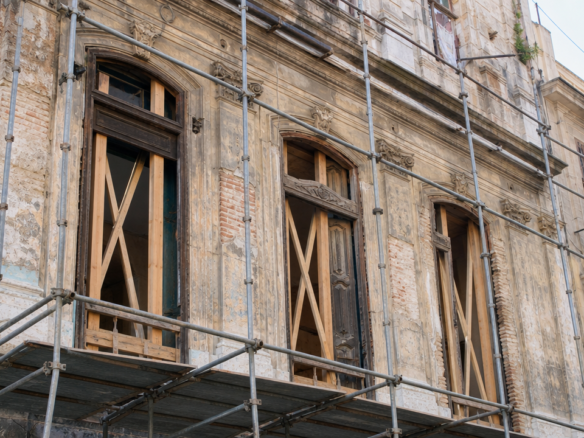
Two details in the new law are worth knowing. A house declared a holiday home, the old casa de veraneo of Varadero or Guanabo, keeps that status when it’s inherited; Article 138.4 says it’s lost on a sale or gift, not on succession. And an empty house isn’t a neutral choice: Article 139.2 asks owners to keep a permanently empty home from falling into disrepair.
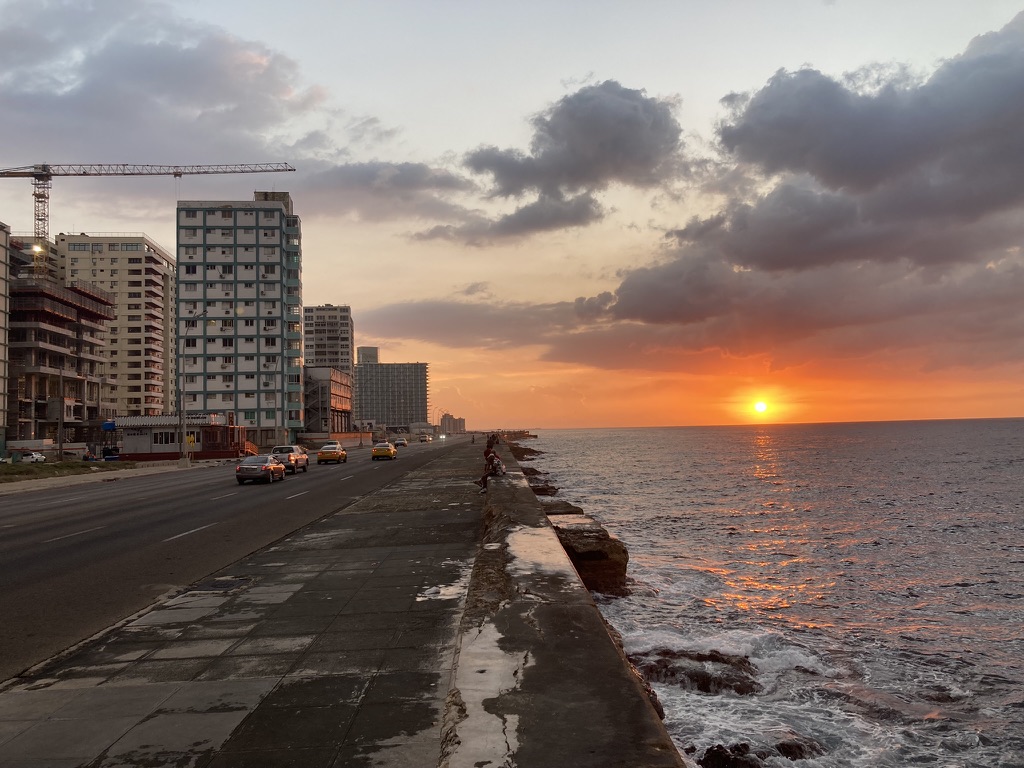
That last point is usually where the family conversation turns practical. A house in Vedado or Miramar that nobody lives in still needs someone with keys, a plumber’s number and a reason to open the shutters. In our experience, the heirs who keep a Havana house happily are the ones who decided early what it’s for.
Cuba Luxury Rent works with owners on both of the other paths. Heirs who want the house to earn its keep can list it with us as owners; those who’d rather sell can start with our property for sale page, where discretion is the default. Either way, inheriting property in Cuba ends with a decision, and the paperwork is easier once that decision is made.
Tell us where the house is, who the heirs are and where they live. We’ll tell you what we see from Havana.
Frequently asked questions
Can a Cuban living abroad inherit a house in Cuba?
Cuba’s Migration Law, Ley 171/2024, Article 31, in force from 1 November 2026, gives Cubans resident abroad the right to use, enjoy and freely dispose of property they own. The Civil Code still lists having definitively abandoned the country as a cause of incapacity to inherit (Article 470). A Cuban lawyer should read both for each family.
How long does an heir have to renounce an inheritance in Cuba?
Three months. Under Article 527 of Cuba’s Civil Code, the term runs from the day after the declaration of heirs becomes final, or, under a will, from when the heir officially learns of it. If the heir doesn’t renounce before a notary or the competent court within that time, the inheritance is considered accepted.
Where is a declaration of heirs filed in Cuba?
With a notary whose seat is in the province of the deceased’s last recognised address in Cuba, under Ley 175/2024, Article 219. The heirs apply in person or through a lawyer and bring the death certificate, proof of kinship and marital status, and a certificate from the Registry of Last Wills and Declarations of Heirs.
What is the inheritance tax on a house in Cuba?
Each heir pays on their own share, under Ley 113/2012, Annex 3. Between parents, children and spouses, shares up to 1,000 pesos are exempt and the rate rises from 2% to 25%; more distant relatives pay more. From 21 October 2026 the base for a house is its valor catastral. Payment is due within 30 calendar days of the deed.
When does Cuba’s new Housing Law take effect?
On 21 October 2026. Ley 187/2026, the Ley de la Vivienda, was published in Gaceta Oficial No. 86 on 14 October 2026 and enters into force seven days later. It repeals Ley 65 of 1988 and the decree-laws that amended it, and its general regulation is Decreto 176/2026.
Written from Cuba Luxury Rent’s work in Cuba since 2000. Legal references read directly from the Gaceta Oficial (No. 86 of 2026, No. 39 of 2026, No. 62 of 2025, Edición Especial No. 1 of 2026) and from the Civil Code as updated on 8 November 2022, current as of October 2026. This is market information, not legal advice; for a specific estate, it’s worth speaking to a Cuban lawyer.


Join The Discussion