
A short-term rental in Cuba is legal when the owner holds prior authorisation from the municipal labour directorate, as Article 74.1 of Cuba’s housing law allows. The price is freely agreed. Since 4 August 2026, Decreto 160 also requires owners who host guests living abroad to report their identity data to the Ministry of the Interior.
Walk down almost any street in Vedado and you’ll spot them: a small sign by the front door telling a passer-by that this house takes guests. Behind each one is an owner who went to the municipal office, got the authorisation and keeps a record of who sleeps under the roof. Most of the owners we’ve worked with since 2000 know that routine by heart.
The rules around it moved this summer. Not the core, which has stood since 2014, but the edges: who has to report what, and where an extra consultation now applies. Here is the whole picture as it reads in the Gaceta Oficial in October 2026.
Who can offer a short-term rental in Cuba?
The owner of the home. Article 74.1 of Ley 65, Cuba’s general housing law, lets owners rent the whole house, rooms with or without their own bathroom, and spaces that form part of the property. The price is whatever owner and guest agree. Two conditions: the house must fit current urban regulations, and the municipal labour directorate must authorise it first.
That wording dates from Decreto-Ley 322 of 31 July 2014, which gave Article 74 of Ley 65 its current text. It’s short, and every line of it matters to an owner. The law says the purpose of letting homes and rooms is hospedaje, lodging. It forbids subletting and any handing-over of the right to use the space. And it names two kinds of tenant an owner may not take: representatives of foreign organisations, firms, entities or countries accredited in Cuba, and legal persons, meaning companies.
That last rule surprises people. A foreign company can’t sign the lease for a house it wants for its staff; the guest is a person. The same law gives Cuba’s Ministry of Labour and Social Security the job of directing and controlling the whole activity, which is why the authorisation comes from a labour office and not from a housing or tourism one.
The phrase “short-term” doesn’t appear in the statute at all. Cuban law draws its line by purpose, not by length of stay: if the home is let for lodging, it’s this regime. In practice a short-term rental in Cuba means a guest who stays days or weeks, pays the owner directly or through an agent, and goes home.
What did Decreto 160 change in August 2026?
It added a reporting duty and an Old Havana rule. Decreto 160, signed by Prime Minister Manuel Marrero Cruz on 22 July 2026, appeared in the Gaceta Oficial on 28 July and took effect seven days later, on 4 August. It replaced Decreto 107 of 2 August 2024 as the rulebook for what Cuba’s private businesses may and may not do.
Its first special provision is the one owners talk about. In the decree’s own words, private economic actors whose activities include letting homes, rooms or spaces to people resident abroad must inform the authorised body of the Ministry of the Interior of the identification data of the tenant and of anyone travelling with them. You can read it on page 1922 of the Gaceta issue that published Decreto 160.

Notice who the decree is talking to. It defines private economic actors as private companies, private micro, small and medium-sized enterprises, non-agricultural cooperatives and the self-employed. So the duty sits with whoever runs the letting, whether that’s a family with two rooms or a registered company managing a building.
The decree doesn’t describe the form or the channel; it says the data are reported “according to what is established”. Ask about the reporting step when you apply for authorisation, and check the details with a Cuban lawyer. Our view is simple. A good owner already knew who was staying in the house. Now it’s written down.
The decree also says the Council of Ministers will review it at least every two years. Anyone running a short-term rental in Cuba should expect the text to move, and read the Gaceta, not a forum post, when it does.
Does a short-term rental in Cuba need extra approval in Old Havana?
Inside a conservation zone, yes, one more step. Decreto 160’s second special provision says that activities within a Zona Priorizada para la Conservación require a consultation with the Office of the Historian or of the Conservator, made through the legally authorised institution. In Havana that’s the Historian’s Office; other historic cities have a Conservator.
This matters most where the demand is. Cuba’s own housing-valuation rule, Resolución 313/2024 of the Ministry of Finance and Prices, in force since 15 November 2024, puts six municipalities in its top band, coefficient 6.0, because each is a Zone of High Significance for Tourism: Playa, Plaza de la Revolución, La Habana Vieja, Trinidad, Cárdenas, which takes in Varadero, and Viñales. The national baseline is 1.5. You’ll find the list in the annexes of Resolución 313/2024.
Ley 65 has its own clause for tourism zones too. Article 109.1 says that in areas the Council of Ministers declares of high significance for tourism, letting rooms or spaces is authorised by the municipal labour directorates under the regulations in force. Same office, same logic.
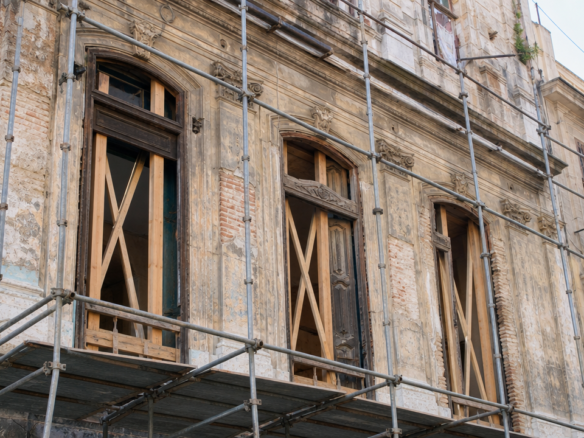
If the house is a listed colonial building, the conservation rules reach further than the guest book. We went through what restoring a colonial building in Old Havana involves in an earlier piece, including the five protection grades that decide what an owner may change.
How is a short-term rental in Cuba taxed?
Through personal income tax. Article 17 of Ley 113 of 2012, Cuba’s tax law, lists among taxable income both earnings from self-employment and income from letting movable or immovable property you own or hold. Article 19 extends the tax to Cubans and foreigners without permanent residence, for income they earn or generate in Cuba.
Read Article 19 twice if you live in Miami or Madrid. Owning the house from abroad doesn’t move its income out of Cuba’s tax net. If the guests sleep in Havana, the income is generated in Havana.
Deductions follow the same law. Article 21 recognises a general deductible expense of up to 10 per cent of income, but lets the annual budget law or the Ministry of Finance and Prices set different limits for specific activities. Rates and limits change from year to year, so we don’t print them. Ask a Cuban accountant for the current figures before the season starts, and keep every receipt.
What should an owner have ready before the first guest?
Four things, all of them paperwork you can show. The municipal labour directorate’s authorisation, which is the licence itself. A house that matches its official description and current urban rules. A reliable way to record each guest’s identity, now that Decreto 160 asks for it for visitors from abroad. And books that would make sense to a tax inspector.
| Rule | What the text says | Source | Current since |
| Right to let | Owners may let the home, rooms and spaces at a freely agreed price | Ley 65, Art. 74.1 | 5 Sep 2014 (DL 322) |
| Authorisation | Prior authorisation of the municipal labour directorate | Ley 65, Art. 74.1 | 5 Sep 2014 (DL 322) |
| Purpose | Letting homes and rooms is for lodging (hospedaje) | Ley 65, Art. 74 | 5 Sep 2014 (DL 322) |
| Excluded tenants | Accredited foreign representatives; legal persons | Ley 65, Art. 74.2 | 5 Sep 2014 (DL 322) |
| Subletting | Prohibited, as is handing over the right of use | Ley 65, Art. 74 | 5 Sep 2014 (DL 322) |
| Guests resident abroad | Identity data of tenant and companions reported to the Ministry of the Interior | Decreto 160, Special Provision 1 | 4 Aug 2026 |
| Conservation zones | Consultation with the Historian’s or Conservator’s Office | Decreto 160, Special Provision 2 | 4 Aug 2026 |
| Income tax | Rental income is taxable; non-residents pay on income generated in Cuba | Ley 113, Arts. 17 and 19 | 2012 |
Sources: Ley 65 in its consolidated text (Gaceta Oficial, 24 July 2017); Decreto 160/2026 (Gaceta Oficial No. 62, 28 July 2026); Ley 113/2012. Read from the official texts in October 2026.
Our honest advice, after a quarter of a century of watching houses in this business: the owners who last are the ones whose papers are boring. Title clean, licence on file, guest register up to date. Nobody remembers them for the paperwork. They remember the terrace.
One trap we see every year is the informal arrangement inside a family. A cousin manages the house while the owner lives abroad, money changes hands, and nobody is sure whose name is on the authorisation. Ley 65 forbids handing over the right of use. Sort out who the authorised person is before anyone takes a booking.
The other trap is the house that changed. A room added on the roof, a garage turned into a studio, a second bathroom nobody declared. Article 74.1 ties the authorisation to a house that matches current urban rules, and the spaces an owner may let are the ones included in the home’s description. If the property on paper and the property on the street have drifted apart, bring them back together before you apply. It’s slower than it sounds, and it’s the step people skip.
How does Cuba Luxury Rent work with home owners?
We visit the house first, in person, and only then prepare the listing. The owner keeps control through an owner dashboard, nothing goes live without their approval, guests pay on arrival, and Cuba Luxury Rent invoices its commission monthly. Every guest is verified: no anonymous bookings.
That last point was on our page for owners long before Decreto 160 made guest identity a legal matter, and it’s the reason we think the new rule is good news for serious owners. A house that already knows its guests loses nothing. A house that didn’t was always a risk to its owner.
Cuba Luxury Rent has worked with Cuban homes and their owners since 2000, and we’re choosy. Look at the homes we list for rent and you’ll see why: a short list, each house seen in person. If you own a property in Havana or Varadero and want it run as a short-term rental in Cuba the way it should be, send us the location, size and a few photos.
Frequently asked questions
Is a short-term rental in Cuba legal for a private owner?
Yes. Article 74.1 of Ley 65, Cuba’s housing law, lets owners let their home, rooms and spaces at a freely agreed price, provided the house fits current urban regulations and the municipal labour directorate has authorised it in advance. The law describes the purpose as lodging.
Who must report foreign guests to Cuba’s Ministry of the Interior?
Since 4 August 2026, Decreto 160 requires private economic actors who let homes, rooms or spaces to people resident abroad to report the identification data of the tenant and companions to the authorised body of the Ministry of the Interior. The decree covers the self-employed and private companies alike.
Can a company rent a private house in Cuba?
Not as the tenant. Article 74.2 of Ley 65 says homes, rooms and spaces may not be let to legal persons, or to accredited representatives of foreign organisations, firms, entities or countries. A company can pay for its people’s stay, but the guest of the house is a person.
Do owners living abroad pay Cuban tax on rental income?
Ley 113 of 2012 makes Cubans and foreigners without permanent residence in Cuba taxpayers for income they earn or generate there (Article 19), and lists property-letting income as taxable (Article 17). Rates and deductible limits change yearly; a Cuban accountant has the current figures.
Is subletting allowed in Cuba?
No. Article 74 of Ley 65 prohibits subletting homes, rooms or spaces, and also prohibits handing over their use to someone else. Only the owner, with the municipal labour directorate’s authorisation, may let the property. This is why family arrangements need a clear authorised name.
Written from our work with Cuban home owners since 2000. Legal references read directly from the Gaceta Oficial and current as of October 2026. This is market information, not legal or tax advice; for your own case, it’s worth speaking to a Cuban lawyer.



Join The Discussion