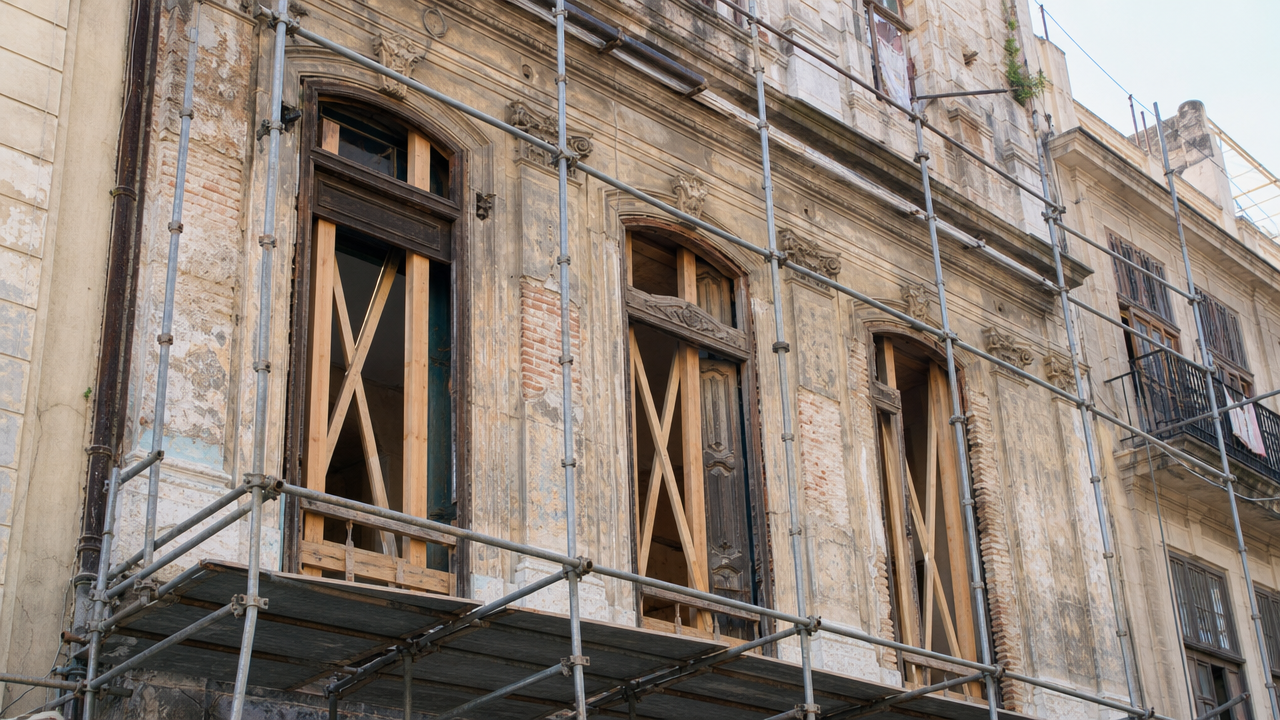
What Does Restoring a Colonial Building in Old Havana Involve?
Restoring a colonial building in Old Havana runs on one classification and one permit. Cuba’s Decreto 92/2023 sets five protection grades for heritage buildings, and inside the Historian’s priority conservation zone every intervention also needs an Autorizo para Obras y Usos. Cuba Luxury Rent reads the grade first. It decides everything after it.
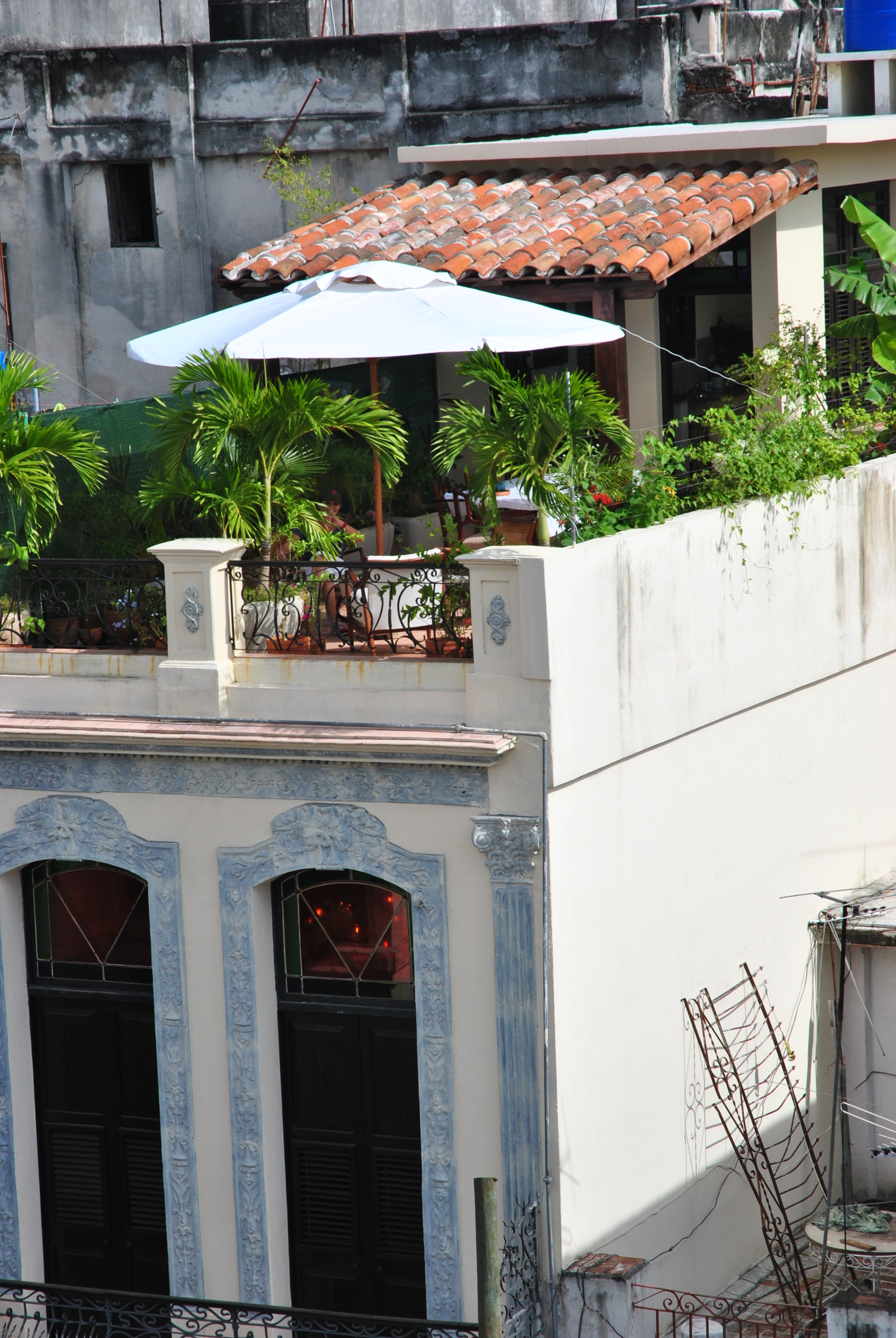
Buyers fall for the patio. Every time. The tiles, the ironwork, the light dropping down the well in the middle of the house – that’s the part people photograph, and that’s the part they price. Then somebody looks up at the roof timbers and the conversation changes, because in Habana Vieja the roof and the ceiling height set the budget and the courtyard sets nothing.
We wrote in July about what a colonial house in Old Havana actually is and stopped short of the money question on purpose. This is the other half. Restoring a colonial building in Old Havana starts with what the Cuban state requires before anyone touches it, who signs, and why two houses on the same block can be two completely different projects.
What does restoring a colonial building mean in Cuban law?
Cuban law has no separate category called restoration. It has intervencion, and Article 153 of Decreto 92/2023 lists 26 kinds of it – new build, change of use, partial demolition, interior alterations, facade changes, roof work, interior and exterior plumbing, even repainting a facade in a colour that isn’t the original. Restoring a colonial building is a bundle of those, not one act.
The two texts that matter both sit in the same gazette. Ley 155/2022, the Ley General de Proteccion al Patrimonio Cultural y al Patrimonio Natural, was approved by the National Assembly on 16 May 2022. Its regulation, Decreto 92/2023, was signed by Prime Minister Manuel Marrero Cruz on 11 July 2023. Both were published in Gaceta Oficial No. 84 Ordinaria on 7 September 2023, and both state that they take effect 180 days after publication – so from March 2024.
That matters more than it sounds. Any Havana due-diligence file written before September 2023 describes a framework that no longer exists. If a survey or an architect’s note cites the 1977 heritage laws, check its date before you rely on a line of it.
Which five protection grades decide what you can do?
Article 136.1 of Decreto 92/2023 is blunt about it: se establecen cinco grados de proteccion. Five grades, numbered I to V. They attach to the building, not to the owner, and they survive a sale. Grade I is reserved for declared National and Local Monuments. Grade V, at the other end, covers structures and plots that may be adapted, modified or even demolished with approval.
The grade is set by committee, and which committee depends on the grade. Article 136.2 gives grade I to the Comision Nacional de Monumentos, on a proposal from the provincial commissions. Grades II to V are approved by the provincial monuments commissions on a proposal from the municipal ones. Whoever approves it tells INOTU, the national planning institute.
Restoring a colonial building starts by finding your row in this table. Every row is the decree’s own language, compressed, with the article number so you can check us.
| Grade | What Decreto 92/2023 allows | Who approves the grade | Article |
| I | Outstanding heritage buildings. Work is aimed at preserving the attributes carrying their integrity, authenticity and exceptional value. New uses and technologies are possible, each subject to rigorous review and approval. Given to declared National and Local Monuments. | Comision Nacional de Monumentos, on a proposal from the provincial commissions | Art. 137 |
| II | Buildings of high value with appreciable authenticity and integrity, and buildings that contribute to the exceptional value of their setting. Work leans to conserving those attributes. New uses must suit the building; changes that improve habitability are allowed if they don’t damage its value. | Provincial monuments commissions, on a proposal from the municipal commissions | Art. 138 |
| III | Buildings of value in their context or for their locality, or whose integrity has already been partly altered. Controlled modifications and adaptations are allowed where they damage neither the building nor its setting. | Provincial monuments commissions | Art. 139 |
| IV | Buildings with environmental value arising from their harmony with grade I, II and III buildings. Modifications, adaptations and partial interior demolitions are allowed with prior approval. | Provincial monuments commissions | Art. 140 |
| V | Potentially buildable land, or structures forming part of a protected property whose conservation is not desirable because it devalues or harms the setting. These may be adapted, modified or even demolished, provided the new work doesn’t worsen the impact on the protected property. Occupying the plot needs approval. | Provincial monuments commissions | Art. 141 |
Source: Decreto 92/2023, Articles 136 to 141, Gaceta Oficial de la Republica de Cuba No. 84 Ordinaria, 7 September 2023 (GOC-2023-759-O84).
Grade V is the line most often misread in Havana paperwork, and it cuts both ways. A grade V tag on a ruined annexe inside a protected ensemble is the difference between a conservation job and a building plot. We’ve seen sellers who had no idea their courtyard outbuilding carried it, and buyers who assumed the grade covered the whole property.
Who approves restoring a colonial building in Habana Vieja?
Two desks, not one, and they’re not interchangeable. Under Article 147, any intervention in a National Monument – and in grade II or III buildings inside it that carry no declaration of their own – needs the Consejo Nacional de Patrimonio Cultural, acting through the Comision Nacional de Monumentos. Grades IV and V go to the provincial commission, under Article 148.
Old Havana has been a National Monument since Resolution 3 of the Comision Nacional de Monumentos, dated 10 October 1978. It was inscribed on the UNESCO World Heritage list four years later, in 1982, under criteria (iv) and (v), as Old Havana and its Fortification System – a 238.7-hectare property with a 412.4-hectare buffer zone. UNESCO’s own file puts the historic centre itself at 214 hectares.
So the address alone tells you which commission you’re dealing with before anybody has looked at the house. That single fact reorders a renovation timetable, and it’s the first thing Cuba Luxury Rent establishes when an owner asks us what a building is worth.
What is an Autorizo para Obras y Usos?
It’s the second permit, and it’s the one people leave out of their schedule. Article 154.1 of Decreto 92/2023 requires the technical documentation to go to the heritage authority for analysis and ruling before any work starts. Article 154.2 adds that inside a Zona Priorizada para la Conservacion, the intervention also requires an Autorizo para Obras y Usos issued by the corresponding Oficina del Historiador.
Ley 155/2022 defines that zone at Article 141: a territory declared as such by the competent authority, made up of cultural sites, ensembles, buildings or remains forming part of the nation’s cultural heritage, which therefore has to be managed in an integrated and specialised way. Havana’s zone is administered by the Oficina del Historiador de la Ciudad de La Habana, an office founded in 1938 whose modern powers rest on Decreto-Ley 143 of 1993, still carried on the Gaceta Oficial register as amended and in force.
Practically, restoring a colonial building inside the zone means two files moving at once, in two different queues, and one of them can stop the other. Article 155 says work carried out without the required approval, or in breach of the approval granted, is suspended. Our opinion, after a quarter of a century of watching this: the people who finish on time are the ones who opened both files in the same week.
Does painting a facade count as an intervention?
Yes – when the paint changes the original colours or breaches urban regulations. That’s Article 153, item (j), in a list of 26. The same article covers awnings and marquees fixed to facades (item u), changes to roof coverings (x), interior transformations (h), interior and exterior plumbing (w), and changes to the height of a building (k).
This is where budgets quietly break. Owners plan the structure, the wiring and the bathrooms, then find that the colour of the front wall, the shape of the shutters and the awning over the door are all regulated, each with its own approval. None is expensive alone. Together they’re a month.
What does restoring a colonial building actually cost?
There’s no honest single figure, and anybody who quotes one before knowing the grade is guessing. The grade sets the method and the method sets the cost. A grade II roof that has to keep its original timber structure and a grade IV one that may be partly rebuilt are two different jobs on the same street, at two different prices.
Four things move the number more than anything else, and none of them is the thing people look at on a viewing:
- The roof and floor structure. Original timber alfarje work has to be repaired in kind on a high grade. Replacing it in concrete is a different building and often a different permission.
- The puntal – the ceiling height. A five-metre room is beautiful and it is also scaffolding, access, and twice the wall surface to consolidate.
- Whether the original carpentry, ironwork and stained glass survived. If the mediopunto has to be remade, it’s remade by hand, by someone trained to do it.
- How many of the 26 intervention categories your project touches. Each one is an approval, and approvals are calendar, and calendar is money in a city where scaffolding is rented by the month.
For scale on what’s out there: writing in Critica Urbana in July 2019, Yamile Perez Guilarte put the historic centre at 214 hectares with around 3,500 buildings, 78 per cent of them residential, and more than 14 per cent carrying high heritage value. That last figure is the one to hold on to. It means most of Habana Vieja is not a monument – and the cost of restoring a colonial building there depends entirely on which side of that line yours falls.
Can you sell a protected building once it’s restored?
It depends on what the building is declared as, and the decree splits the two cases cleanly. Article 125 says transferring ownership of a privately held asset declared Patrimonio Cultural de la Nacion needs prior authorisation: up to 10 calendar days for a Monumento Local from the territorial heritage structure, up to 20 from the Consejo Nacional de Patrimonio Cultural for everything else.
Article 126 handles the commoner case. A privately owned building declared Patrimonio Cultural, without the de la Nacion status, needs no prior authorisation to change hands – the transfer is notified to the provincial branch of the Registro Central afterwards. Two different clocks, one word of difference in the declaration. The rest of the conveyance runs the way we set out in how a Cuban property sale actually closes. Where the declaration is unclear, it’s worth putting the question to a Cuban lawyer before signing anything.
Who still knows how to do this kind of work?
The trades are taught in-house, and the decree says so. Article 121 lists the escuelas taller y de oficios de la restauracion run by the historians’ and conservators’ offices as one of the routes for training heritage specialists, alongside university degrees in architecture, art history, civil engineering and conservation. Stonecutting, forging, joinery, plasterwork, glazing, mural painting.
It’s the reason a properly restored Havana facade looks right and a badly restored one looks like a film set. The person who cut the stone was trained three streets away, on the same stone, by someone who had done it for thirty years. You can’t import that and you can’t rush it.
For what the finished version looks like, there’s Nodo Habana. The Gobierno Provincial de La Habana described it in January 2025: a 1920s Malecon mansion built for Celia Sarra and Marco Octavio Averoff, stripped during the 1933 upheaval, turned into a tenement by the 1960s, and brought back by the Oficina del Historiador this century. It hosts the fourth Bienal de Arquitectura in November 2026, opening in Havana and closing in Mexico City in December.
What changed when Ley 155 replaced the 1977 laws?
The instruments changed, and the numbers with them. In its sixth final provision, Ley 155/2022 repeals Ley 1, the Ley de Proteccion al Patrimonio Cultural, and Ley 2, the Ley de los Monumentos Nacionales y Locales, both dated 4 August 1977. Decreto 92/2023 then repealed their implementing decrees: Decreto 55 of 1979, Decreto 118 of 1983 and Article 19 of Decreto 272 of 2001.
Which produces a quiet trap that we walked into ourselves before we read the gazette. UNESCO’s protection and management text for dossier 204 still describes Old Havana as protected by Law No. 1 and Law No. 2 of 4 August 1977. We read that page on 14 September 2026 and it says so today. UNESCO isn’t wrong about what protects the site; the file simply predates the new statute. But if a lawyer, an agent or a valuation report quotes those 1977 laws at you as current, you now know exactly how old that paragraph is.
What should you check before restoring a colonial building?
Four things, in this order, and all four before the architect draws anything. The protection grade of the building. Whether it sits inside the Zona Priorizada para la Conservacion. Which commission holds the approval for that grade. And what the roof structure is actually made of. Cuba Luxury Rent asks about the grade before it asks about the rooms.
The order isn’t arbitrary. Grade decides authority, authority decides timetable, timetable decides cost, and the roof decides whether any of it is worth doing. Reverse that sequence – which is what most people do, because the rooms are the fun part – and you find out in month five that the scheme you paid for can’t be approved.
Cuba Luxury Rent has worked in Cuba since 2000, from a Havana base. What we sell on a building like this isn’t a renovation quote. It’s knowing which grade a house carries, which desk signs for it, and which of the two answers is going to be the slow one. If you own something in Habana Vieja, or you’re circling one and want the grade checked first, bring it to the concierge desk and we’ll tell you what you’re actually buying.
Frequently asked questions
How many heritage protection grades does Cuba have?
Five, numbered I to V, set by Article 136.1 of Decreto 92/2023. Grade I covers declared National and Local Monuments. Grade V covers buildable land and structures that may be adapted, modified or demolished with approval. The grade attaches to the building rather than the owner, and it survives a sale.
Do I need permission to repaint the facade of a colonial house in Old Havana?
Yes, where the paint changes the original colours or breaches urban regulations. Article 153 of Decreto 92/2023 lists facade painting in those circumstances among 26 categories of intervention on immovable cultural heritage, together with awnings, roof coverings, window and door alterations, and changes to a building’s height.
Who issues the Autorizo para Obras y Usos in Havana?
The Oficina del Historiador de la Ciudad de La Habana, for work inside the Zona Priorizada para la Conservacion. Article 154.2 of Decreto 92/2023 makes it an additional requirement on top of the heritage authority’s ruling on the technical documentation, so a project inside the zone carries two approvals, not one.
Can a protected building in Old Havana be demolished?
Grade V structures can be, with approval. Article 141 of Decreto 92/2023 applies grade V to buildable land and to structures inside a protected property whose conservation is not desirable, and allows them to be adapted, modified or demolished provided the new work does not worsen the impact on the protected property.
Does selling a protected building in Cuba need prior authorisation?
If it is declared Patrimonio Cultural de la Nacion, yes. Article 125 of Decreto 92/2023 gives the territorial heritage structure 10 calendar days to answer for a Monumento Local and the Consejo Nacional de Patrimonio Cultural 20 for other assets. Buildings declared only Patrimonio Cultural need no prior authorisation, only notification afterwards.

Join The Discussion