
The value of a Havana home is decided house by house. Since 21 October 2026, Cuba’s catastral method, Resolution 16/2026, raises a home’s official value for a corner plot, solid build quality, good condition, height and a heritage zone, and lowers it for the opposite. Cuba Luxury Rent checks the same things before a home goes up for sale.
Picture two houses on one Vedado block. Same street, same number of bedrooms, built a few years apart. One sits on the corner under a concrete roof and has had its walls looked after. The other is mid-block, with an interior lot behind it and a staircase nobody has touched since the 1980s. Ask a neighbour which one is worth more and they’ll answer before you finish the question. Since October, the State’s own method gives the same answer, in numbers.
We’ve been in Cuba since 2000 and have walked a lot of buyers through a lot of front doors. This piece sets out what the official method counts, what the market counts on top of it, and where the two part ways. It’s written as of November 2026, from the text of Gaceta Oficial No. 86 of 14 October 2026, which carried the new Housing Law and the new catastral method in the same issue.
How is the value of a Havana home calculated in 2026?
Under Resolution 16/2026 of Cuba’s planning institute, INOTU, the catastral value is the value of the land plus the value of what’s built on it. Each is worked out per square metre, then multiplied up or down by fixed correction factors. The method lists six physical characteristics it reads from the National Cadastre.
They are the built and unbuilt surface, the building material, the date of construction, the state of the construction, the services the property has, and its use. The land side starts from the zone, narrows to a “polygon” of similar blocks and then to the street, or the stretch of street, the home stands on. The construction side starts from the building type and its use, and corrects for age and condition.
Two lines in the method matter more than the formulas. The catastral value “must keep a relation” with market value, and “can never exceed it”. And the value of each property is published on the Catastro’s website. The resolution took effect seven days after publication, on 21 October 2026, and repealed Resolution 173 of 2022.
Why it matters at a sale: the new Housing Law, Ley 187/2026, rewrote Articles 44 and 203 of the tax law in its Fourth Final Provision. For a sale, the tax base is the agreed price, provided it’s equal to or higher than the catastral value. We explained the older two-value system in how Cuba values a home; this is the method that now sits behind the second of those values.
Why is a corner house worth more than the one next door?
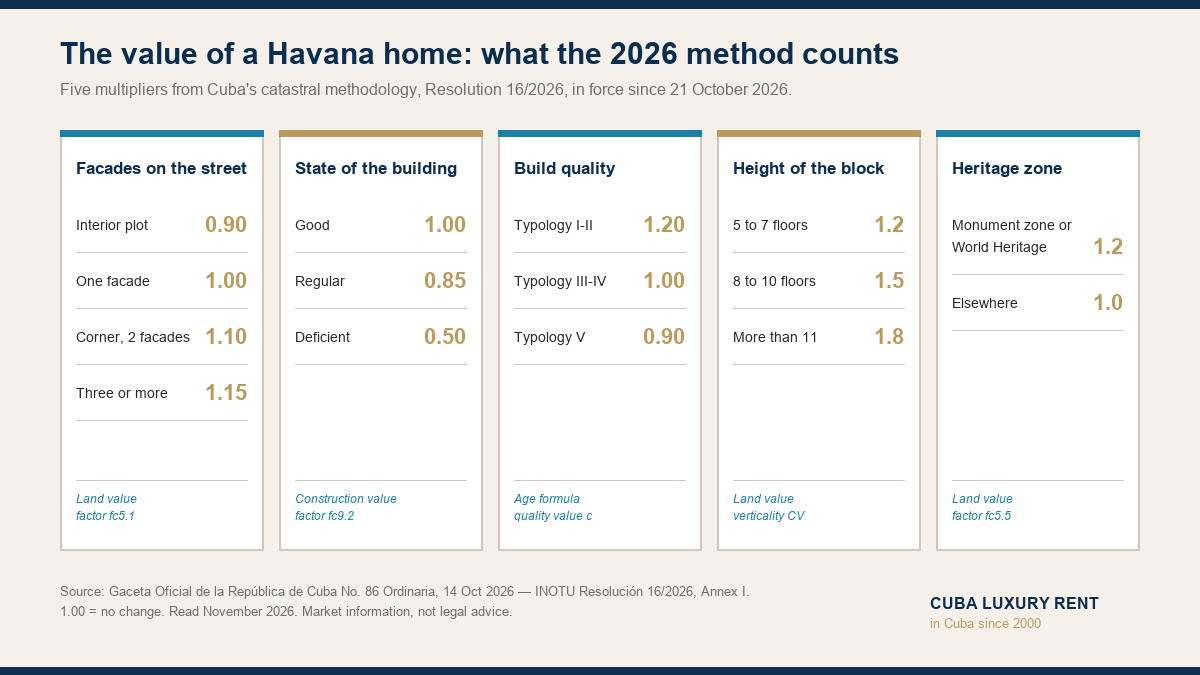
Because the method says so, in plain numbers. A home with one facade on the street gets a land factor of 1.00. Two facades, the usual corner, gets 1.10. Three or more, 1.15. A plot with no facade on the street at all, an interior lot, drops to 0.90. So the best-placed plot on a block counts about 28% more land value than the one tucked behind it.
Two more land factors pull the other way. An irregular plot whose shape gets in the way of building on it can be marked down to 0.85. And a frontage much shorter than the local minimum is cut in proportion, never below 0.6.
The market adds its own reasons. A corner house in Havana has light and air on two sides, and from June to September the cross-breeze is worth more than a second bathroom. We’d pay for the corner too.
Does the value of a Havana home depend on its roof and walls?
Yes, twice over. In Resolution 16/2026, a building’s construction typology sets a quality value in the age formula: 1.20 for typologies I and II, 1.00 for III and IV, 0.90 for V. Typology I covers masonry or block walls under concrete slabs or beam-and-vault roofs; typology II, the same walls under clay tile.
The Finance Ministry’s reference-value tables, Resolution 313/2024, in force since 15 November 2024, make the same point in pesos. Each bedroom of a house with masonry walls and a heavy roof (reinforced concrete, beam and slab, joist and block) counts 90,000 CUP before the location coefficient. Under a light roof, 60,000. Walls and roof of any other material, 30,000.
Run that through Annex II, the 6.0 band that covers Plaza de la Revolución, Playa and La Habana Vieja. A three-bedroom heavy-roof house with a garage and a patio comes out at 1,815,000 CUP. The same house under a light roof, 1,275,000. The roof alone moves the official figure by 540,000 pesos.
Here’s a detail you’ll only catch by reading both texts. Resolution 313/2024 puts clay-tile roofs with the light ones. Resolution 16/2026 puts them in typology II, beside concrete. Same roof, two answers. Which yardstick a notary applies on a given deed is a question for a Cuban lawyer, not for us.
How much does the condition of a building change its value?
More than any other single factor. Resolution 16/2026 multiplies the construction value by 1.00 for a building in good condition, by 0.85 for regular, and by 0.50 for deficient. A well-kept building keeps all of its construction value; the same building, left alone, can keep half.
The age factor has a useful twist. The method counts T, the full years since construction “or total (capital) repair”. A full restoration restarts the clock the formula runs on. Where the year of construction can’t be identified, the age coefficient isn’t applied at all.
In our experience, the people who restore well in Havana are the ones who saw the value in the structure, not on the façade. If you’re thinking about that route, we set out the permits and the five protection grades in restoring a colonial building in Old Havana.
| Factor in Resolution 16/2026 | What it does | Range |
| Facades on the street (fc5.1) | Raises or lowers land value | 0.90 interior · 1.00 one · 1.10 two · 1.15 three+ |
| Plot shape (fc5.3) | Lowers land value if the shape blocks building | 0.85 |
| Heritage or special zone (fc5.5) | Raises land value | 1.2 |
| Height of the building (CV) | Raises land value above 5 floors | 1.2 · 1.5 · 1.8 |
| Build quality (c) | Enters the age formula | 1.20 types I–II · 1.00 III–IV · 0.90 V |
| Age (T) | Years since construction or capital repair | Formula, table 10 |
| State of conservation (fc9.2) | Multiplies construction value | 1.00 good · 0.85 regular · 0.50 deficient |
What sets the value of a Havana home in Cuba’s catastral method, as of November 2026. Source: INOTU Resolution 16/2026, Annex I, Gaceta Oficial No. 86, 14 October 2026; in force 21 October 2026. 1.00 means no change.
Why do tall Vedado buildings carry more land value?
Because the method adds a verticality coefficient to the land under buildings of more than five floors: 1.2 for five to seven floors, 1.5 for eight to ten, and 1.8 for more than eleven. More homes stand on the same square metre, so the land under them counts for more.
For a flat, the method then shares the building’s value out. It takes the catastral value of the whole building and multiplies it by the flat’s built area divided by the built area of the whole building. The same rule covers homes built on another’s roof. Floor area decides your slice. The view doesn’t enter the formula at all.
Does a heritage zone raise the value of a Havana home?
On the land side, yes. A home in a zone declared a National or Local Monument, or inscribed on UNESCO’s World Heritage List, as Old Havana is, takes a land factor of 1.2 under Resolution 16/2026. So does a zone the State later sets aside for tourism or other priority investment.
The same status brings rules on what you can change. Decreto 92/2023, Cuba’s heritage regulation, sets five protection grades, from grade I for the most important buildings to grade V for plots whose current building can be adapted or replaced. Before buying in Old Havana, ask for the grade first and the price second.
What does the official value of a Havana home leave out?
Almost everything you feel when you walk in. The catastral value of a Havana home doesn’t see ceiling height, though Decreto 176/2026, the Housing Law’s general regulation, lists the height of the puntal among the technical elements for declaring a home adequate. It doesn’t see the light at four in the afternoon, the staircase, or who lives upstairs.
Here’s what we look at first, in this order. The ceiling: a four- or five-metre puntal in a Vedado house from the 1920s is something no modern block in the city can copy. The staircase and the roof, because that’s where water goes. And the papers. Under Article 90.2 c) of Ley 187/2026, a seller must prove the home is entered in the Central Property Register before selling it.
Two more lines are worth knowing. Article 18.4 of Decreto 176/2026 gives a catastral certificate a life of five years from issue. And the method itself foresees a new valuation for a polygon when its catastral values fall to 50% of market value or less. The State expects the gap, in other words, and has a rule for when it gets too wide.
How does Cuba Luxury Rent assess a Havana home for sale?
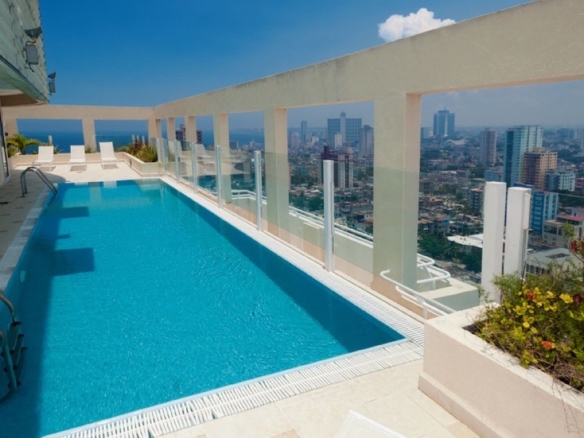
The same way, by hand. Before a home goes on our property for sale in Cuba page, Cuba Luxury Rent has the title documents reviewed by its legal desk, the building inspected and the neighbourhood assessed honestly. Prices are on request. Today there’s one home on the list, Maison Habana Vieja, with its roof terrace over Old Havana.

If you own a Havana home and want to know how it reads, on paper and to a buyer, write to us from that page or from our contact form. We’ll start with the corner, the roof and the papers, in that order.
Frequently asked questions
What is the valor catastral of a home in Cuba?
It’s the administrative value Cuba’s cadastre gives a property: the value of its land plus its construction, under INOTU Resolution 16/2026, in force since 21 October 2026. It must relate to market value and can never exceed it. Since Ley 187/2026, it’s the floor for the tax base when a home is sold.
Is a corner house in Havana worth more?
Under Cuba’s 2026 catastral method, yes. Resolution 16/2026 gives land with two facades on the street a factor of 1.10 and three or more 1.15, against 1.00 for one facade and 0.90 for an interior plot. Buyers in Havana add their own premium for light and cross-breeze.
Does renovating a Havana home raise its catastral value?
It can. Resolution 16/2026 multiplies construction value by 1.00 in good condition, 0.85 in regular and 0.50 in deficient condition, and counts a building’s age from construction or from a total (capital) repair. A full restoration therefore improves both inputs. The new value applies once the cadastre records it.
How is an apartment’s catastral value calculated in Cuba?
Resolution 16/2026 values the whole building first, then multiplies that figure by the apartment’s built area divided by the built area of the whole building. Buildings of more than five floors also carry a verticality coefficient on their land: 1.2, 1.5 or 1.8 depending on height.
Can the catastral value be higher than the market price?
No. Annex I of INOTU Resolution 16/2026, published in Gaceta Oficial No. 86 on 14 October 2026, says the catastral value must keep a relation with market value and can never exceed it. The method also foresees a new valuation where catastral values fall to 50% of market value or less.
Nothing in this article is legal advice. Cuba Luxury Rent describes the published rules as of November 2026; for a specific home or deed, check with a Cuban lawyer.


Join The Discussion