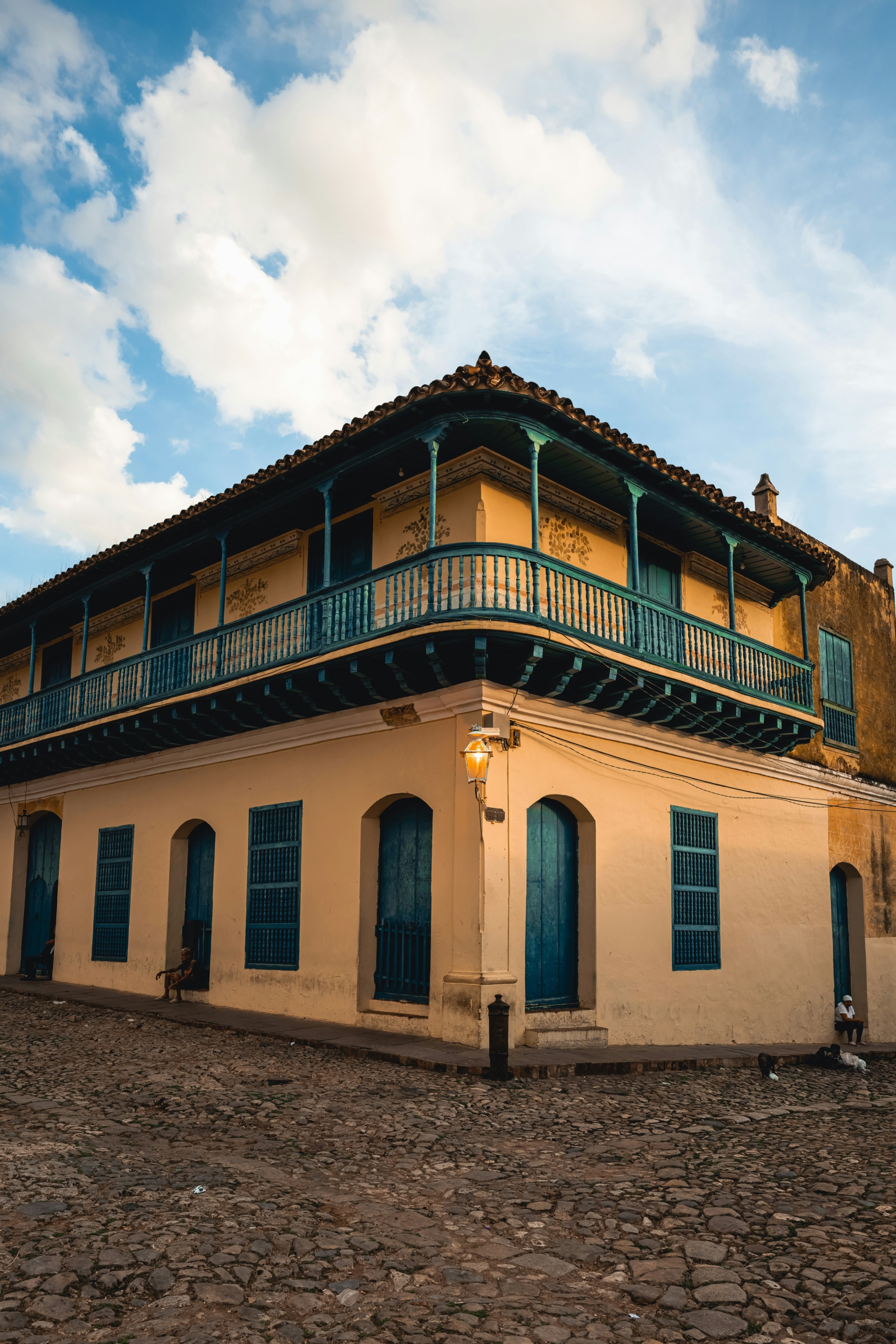
What Is a Colonial House in Old Havana?
A colonial house in Old Havana is a building type, not a decorating style. Cuba’s Oficina del Historiador classifies each of the 3,370 buildings in the 214-hectare historic centre by architectural typology – zaguán, patio, crujía, entresuelo – and by a heritage protection grade that decides what an owner may legally change. About 500 rank as high heritage value.
Walk down Mercaderes and every second doorway looks colonial. Heavy double doors, a cool tiled passage, a patio with a plant in it, iron over the windows. The look is everywhere. The classification is not, and the gap between the two is where buyers, renters and restorers lose money.
Cuba Luxury Rent has worked in Cuba since 2000, with people on the ground in Havana, and this is the question we field most often from people abroad who have fallen for a photograph. Is it colonial? Usually the honest answer is: partly, and that’s not the useful question anyway. The useful question is what grade it carries.
What exactly is a colonial house in Old Havana?
It’s a house built to a defined plan type, which the Oficina del Historiador’s Plan Maestro catalogues by name. The core types run from unifamiliar uniplanta simple – one storey, one front room, rooms in a line beside a side patio – up to the two-storey complex house with a zaguán, galleries on the patio, and an entresuelo squeezed into the ground floor’s height.
That catalogue is not decoration. Under the Plan Maestro’s own Regulaciones Urbanísticas, three things govern what happens to any building in the historic centre: the urban intensity zone it sits in, its architectural typology – which conditions the permitted use – and its heritage protection grade, which conditions the construction work allowed on it. Type first, then use, then works.
So a listing that says colonial is telling you about the facade. The Plan Maestro file tells you about the house.
Which features define a Havana colonial house?
Five, and the Plan Maestro glossary defines each. The zaguán is the covered entrance passage that originally let carts, calesas and carriages drive in. The patio ventilates. The crujía is the structural bay running parallel to the facade. The entresuelo is a habitable floor between the ground and main floors. The puntal is the height between two finished floor levels.
Puntal is the one people feel before they can name it. You step in off a narrow street and the ceiling is somewhere above four metres, the air is five degrees cooler than the pavement, and the room is doing that without a machine. In a proper colonial house the patio and the puntal are the air conditioning; the galleries around the patio are the corridor and the shade at the same time.
The Plan Maestro also splits the rooms by rank. Principal spaces are the zaguanes, vestibules, salón and dining room, galleries and main patio. Secondary spaces are the bedrooms, back patios, kitchens and bathrooms. That hierarchy is why the beautiful part of one of these houses is almost always the part you pass through rather than the part you sleep in – and why a conversion that turns the patio into rooms destroys most of what made it worth converting.
Why are most “colonial” houses in Old Havana not colonial?
Because the arithmetic says so. The Oficina del Historiador’s Plan Maestro puts roughly two-thirds of Old Havana’s total building stock in the first decades of the 20th century – mostly two and three storeys, high puntales, facades carrying balconies, cornices and assorted decorative work. Colonial in feel, republican in date.
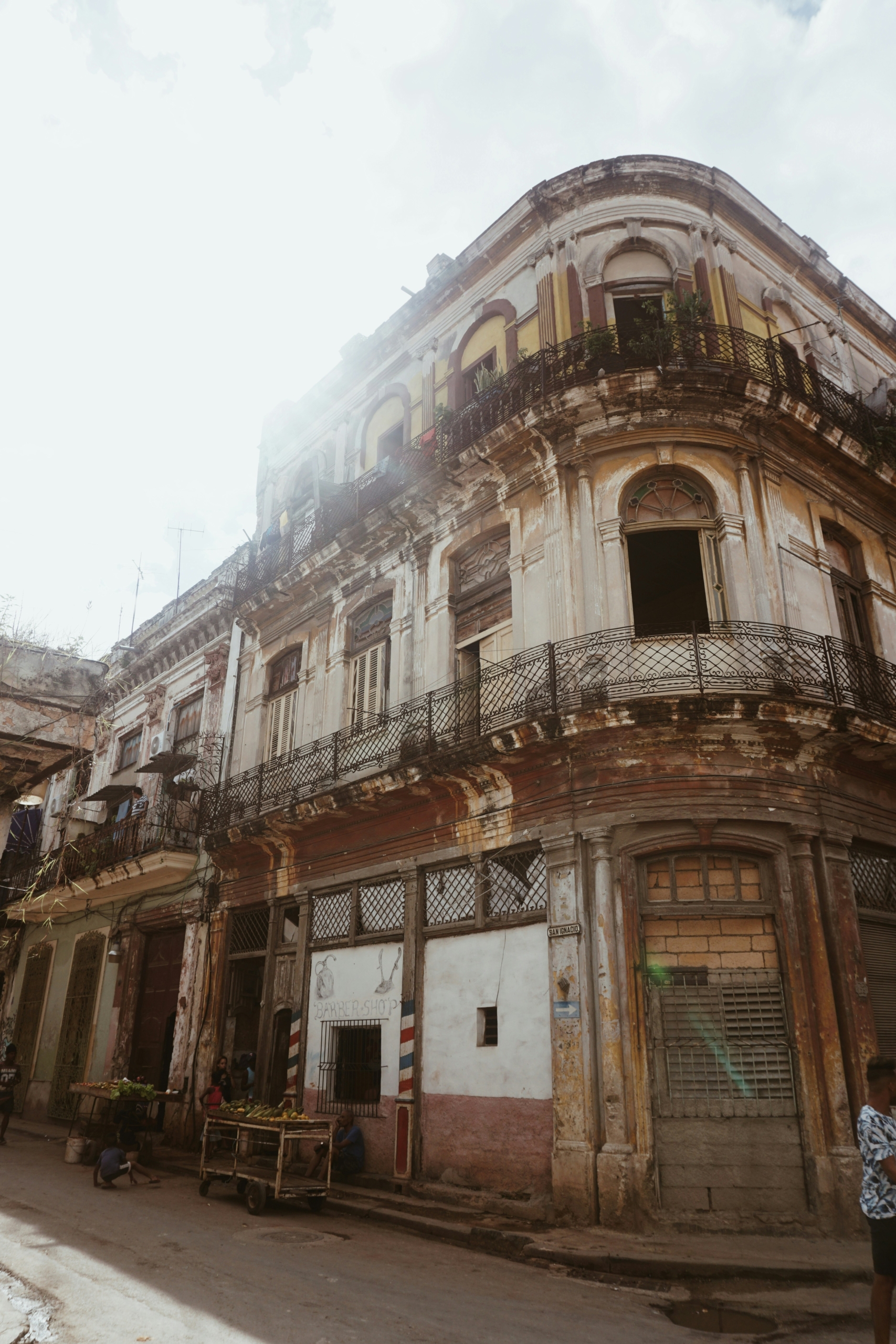
The genuinely old, genuinely important buildings are a minority and the Plan Maestro counts them: about 500 of the 3,370 buildings are considered of high heritage value. Call it fifteen percent. The rest run from good early-republic buildings that borrowed the colonial plan to later infill that borrowed nothing.
This is not a complaint about the housing stock. It’s the single most useful thing to know before you look at anything. A 1915 building on a colonial parcel, with the zaguán and the patio intact, can be a better house to live in than an 18th-century one – and a completely different proposition legally, because the paperwork follows the grade, not the romance.
How does Cuba grade a protected building?
On five levels, I to V, set by Decreto 92/2023, the regulation of Ley 155/2022, published in Gaceta Oficial No. 84 Ordinaria of 7 September 2023. Article 136.1 states plainly that five grades are established. Grade I is approved by the Comisión Nacional de Monumentos; grades II through V are approved by the provincial commissions.
Worth flagging a conflict, because anyone researching this will hit it. The Plan Maestro’s own online glossary still describes four grades, citing Decreto No. 55 of 1979. Decreto 92/2023 establishes five. We use the 2023 text: it is the later instrument, it is the regulation of the law currently in force, and Ley 155/2022 came into force 180 days after its publication under Disposición Final Octava – early March 2024. The glossary hasn’t caught up. Both readings are on the record; one of them is current.
Cuba’s five heritage protection grades, and what each one permits
| Grade | Applies to | What the text permits | Source |
| I | Outstanding immovable cultural property; given to buildings declared Monumento Nacional or Monumento Local | Conservation aimed at preserving integrity, authenticity and exceptional value; new uses and technologies possible, all subject to rigorous review and approval | Decreto 92/2023, Art. 137 |
| II | High-value buildings with appreciable authenticity, and buildings contributing to the value of their setting | Conservation-led; new uses in keeping with the building; alterations that improve habitability without harming its value | Decreto 92/2023, Art. 138 |
| III | Buildings of value in their context or locality, or whose integrity has been partly altered | Controlled modifications and adaptations that harm neither the building nor its context | Decreto 92/2023, Art. 139 |
| IV | Buildings with environmental value through their harmony with grade I, II and III buildings | Modifications, adaptations and partial interior demolition – subject to prior approval | Decreto 92/2023, Art. 140 |
| V | Potentially buildable land, and structures inside a protected property whose survival devalues the setting | Adaptation, modification, even demolition, provided the new work does not worsen the impact on the protected property; lot occupation needs approval | Decreto 92/2023, Art. 141 |
Read for Cuba Luxury Rent from Gaceta Oficial No. 84 Ordinaria of 7 September 2023, in Spanish, on 7 September 2026.
Who has to approve work on a protected Havana house?
Two bodies, in sequence. Ley 155/2022 gives the Comisión Nacional de Monumentos the job of approving interventions in a building declared Monumento Nacional, and in any grade I, II or III construction forming part of one. In the historic centre, the Oficina del Historiador’s Plan Maestro runs the urban planning side – land use, technical opinion, construction licence.
That matters in Old Havana specifically, because the whole historic centre and its colonial fortification system were declared a National Monument by Resolution 3/1978 of the National Monuments Commission – the protection UNESCO cites for the site it inscribed in 1982 under criteria (iv) and (v), 238.7 hectares with a 412.4-hectare buffer zone. A grade II house on Obispo isn’t a private matter with a heritage footnote. It is a component of a declared monument.
The practical consequence is a sequence, not a wall. Work gets done in Habana Vieja constantly. It gets done on paper first. Anyone planning restoration should take the specific building’s grade to a Cuban lawyer and to the Plan Maestro before they price a single beam.
Can a protected colonial house be sold freely?
Not silently. Ley 155/2022, Article 81.1, obliges the parties to any act transferring ownership or possession of property registered as Patrimonio Cultural to report it to the Registro Central de Patrimonio Cultural y Patrimonio Natural. Article 82 goes further for property inscribed as Patrimonio Cultural de la Nación.
Under Article 82.1 the parties must notify the Consejo Nacional de Patrimonio Cultural of their intention. Under 82.2 that Council may exercise a right of tanteo y retracto on the sale – pre-emption before it, redemption after it. In plain terms: on a declared piece of national cultural property, the state can step into the buyer’s shoes.
How often it is used, and against what, is not something the Gaceta answers. What the text does say is that the duty to notify exists and the right exists. Anyone buying inside the historic centre should have a Cuban lawyer confirm, in writing, whether the specific building sits on that register – and what its grade is. Those are two separate questions with two separate answers.
What is a ciudadela, and why should a buyer care?
A ciudadela is a single building housing many families in a row of rooms around a shared patio, with bathrooms, kitchen and washing shared too. The Plan Maestro’s glossary dates its major spread in Havana to the 19th century. A cuartería is the same outcome by a different route: an originally single-family house subdivided speculatively.
This is the other half of the answer to what a colonial house in Old Havana is today. The Plan Maestro reports that close to half the dwellings in the historic centre sit in ciudadelas or cuarterías, and that a large share carry barbacoas – the glossary’s word for a home-built mezzanine inserted into a room with a high puntal. The high ceiling that makes these houses beautiful is exactly what made the mezzanine possible.
Two things follow, and they pull in opposite directions. A palacete carved into eight households is a title problem before it is a building problem. And a house that was never carved up, with its plan intact, is rarer than the facades on any given street suggest. That’s most of why the good ones command what they command.
How does Old Havana’s address change a home’s tax value?
It multiplies it. Resolución 313/2024 of Cuba’s Ministry of Finance and Prices, published in Gaceta Oficial No. 102 Ordinaria of 1 November 2024 and in force from 15 November 2024, sets the minimum reference values used to assess tax on sales and donations of homes between private individuals, with a location coefficient by municipality. La Habana Vieja carries the top coefficient, 6.0.
So the same floor area, in the same condition, is assessed at a different value in Habana Vieja than in Cerro – before anyone argues about what the house is worth. We worked through the full tier table in an earlier piece on how the Cuban state ranks Havana’s neighbourhoods, and through the valuation mechanism itself in our note on the valor catastral.
What should you check before renting or buying one?
Five things, in this order: the protection grade, the architectural typology on file, whether the building is on the cultural property register, the ownership history – one title or eight – and the physical state of roof, beams and the patio’s drainage. The first three come from documents. The last two decide the budget.
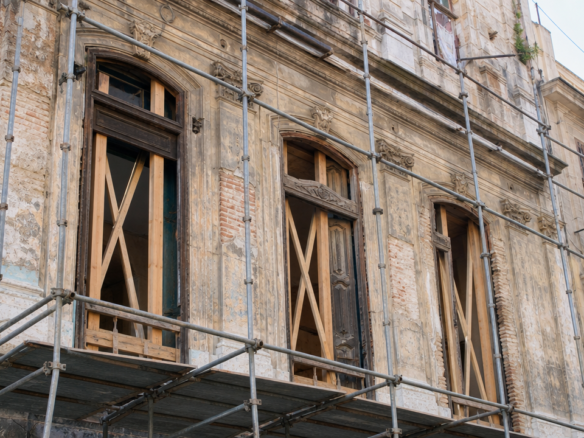
A note on that fifth point, because it’s the one people underestimate from photographs. The Plan Maestro states in its own words that the construction condition of the existing stock is far from satisfactory, and attributes it to age, intensive use and the absence of systematic maintenance. A building whose plan survived a century of that is a genuinely good asset. Restoring one is a specialist job, priced in Havana, by people who have done it before.
What Cuba Luxury Rent brings to this is presence and record: an office in Havana, work in Cuba since 2000, and enough of these buildings walked to know which questions get answered on paper and which only get answered on site. If you’re weighing a specific address in the historic centre, ask us about it through the concierge desk or the contact page. We’ll tell you what we know, including when the answer is that you need a Cuban lawyer and a structural engineer before anything else.
FAQ
Q1. Is every old building in Habana Vieja a colonial house?
No. The Oficina del Historiador’s Plan Maestro puts roughly two-thirds of Old Havana’s building stock in the first decades of the 20th century, mostly two and three storeys with high ceilings and decorated facades. About 500 of the 3,370 buildings are considered of high heritage value.
Q2. What is a zaguán in a Havana house?
The Plan Maestro glossary defines the zaguán as a covered space giving access to a building, which originally allowed carts, calesas and carriages to drive in. In Old Havana it is the passage between the street door and the patio, and it is one of the markers that a house follows a colonial plan type.
Q3. How many heritage protection grades does Cuba have?
Five, numbered I to V, established by Article 136.1 of Decreto 92/2023 in Gaceta Oficial No. 84 Ordinaria of 7 September 2023. Grade I is approved by the Comisión Nacional de Monumentos; grades II to V are approved by the provincial monuments commissions on proposals from municipal ones.
Q4. Does the state have to be told when a protected house is sold?
Yes. Article 81.1 of Ley 155/2022 obliges the parties to report transfers of property registered as Patrimonio Cultural to the Registro Central. Article 82 requires notice of intention to the Consejo Nacional de Patrimonio Cultural for property declared Patrimonio Cultural de la Nación, which may then exercise tanteo y retracto.
Q5. What makes one Havana colonial house worth more than the next?
Plan intactness, protection grade and title. A house whose zaguán, patio, galleries and room hierarchy survive undivided is rarer than the street facades suggest, because the Plan Maestro records close to half the historic centre’s dwellings sitting in ciudadelas or cuarterías. Location also moves the assessed tax value.

Join The Discussion