Who Actually Runs Cuba’s Luxury Hotels Now?
Luxury hotels in Cuba: The big foreign hotel operators have left Cuba. Melia stopped managing its Cuban hotels on 24 July 2026, Iberostar the same day, Canada’s Blue Diamond on 30 May. The buildings stayed open under the Cuban state companies that own them, and at least nine have already been renamed. India’s MGM Muthu is still there.
On 28 July, workers put a ladder against the front of the Hotel Cohiba in Vedado and took the Melia lettering off the facade. Thirty-six years came down in an afternoon.
That photograph went around the world. The part that matters to anyone booking a suite or quoting a group is duller and far more useful: the sign changed, the owner didn’t. Gaviota, Gran Caribe and Cubanacan owned those hotels the whole time. What left the island was the management contract, the reservation system, and the phone number you called when something went wrong at two in the morning.
Cuba Luxury Rent has worked in Cuba since 2000, with people in Havana the whole time, and brands have come and gone before. Not like this. In eight weeks the island lost the operators behind roughly four fifths of its branded room stock. Here is the map as it stands at the end of August 2026, checked against each chain’s own website rather than a booking site.
Which foreign hotel brands still operate in Cuba in August 2026?
Three foreign operators were still marketing Cuban hotels on their own corporate websites when we checked on 28 August 2026: India’s MGM Muthu, with thirteen Cuban properties and a live booking engine; Spain’s Blau Hotels, with three; and Spain’s Roc Hotels, which keeps a Cuba section. Melia, Iberostar, Blue Diamond and Kempinski list none.
MGM Muthu is the surprise. While everyone else was drafting exit statements, its Cuba page kept growing: Gran Muthu Habana and Gran Muthu Habana Tower in Miramar, four in Cayo Guillermo, and properties in Cayo Santa Maria, Holguin, Santiago, Varadero and Cayo Coco. Thirteen entries, two of them marked opening soon, several of them on Gaviota-owned buildings.
Blau still shows Blau Varadero, Blau Las Morlas Varadero Beach and Blau Arenal Habana Beach. Valentin Hotels is the quiet one: its own hotel directory no longer contains the word Cuba at all, though the chain has announced nothing.
One caution from experience, and it applies to every name in the paragraphs above. A bookable page is not a working hotel. We have seen Cuban properties take reservations online for months while the building sat dark because the grid wouldn’t hold and the staff had been sent home. Treat a live website as evidence of a commercial relationship, nothing more.
Why did Melia, Iberostar and Blue Diamond leave Cuba?
Exposure, not politics. Executive Order 14404, signed 1 May 2026, set 5 June 2026 as the deadline for foreign companies to wind down business with entities tied to the military conglomerate GAESA and its tourism arm Gaviota. On 13 July 2026 the US State Department designated ten more entities, among them Cuba’s Ministry of Tourism itself.
That second step broke the compromise. Until July, a chain could argue it dealt with MINTUR-side companies rather than the military side. Once the ministry itself was named, the chains with American assets did the arithmetic. Melia has a dozen hotels in the United States and thousands of Helms-Burton claims against it. Cuba was a small share of its earnings and an open-ended share of its legal risk.
The scale is worth stating plainly. Before the exits, Spanish chains ran 65 hotels and 25,440 rooms in Cuba, according to Hosteltur on 21 July 2026. Melia alone had 33 hotels and 13,891 rooms; Iberostar 19 hotels and 6,978 rooms. Between them, about 80% of the branded national offer. Canada’s Blue Diamond handed back 11,139 rooms on 30 May 2026 across five brands at once: Royalton, Memories, Starfish, Mystique and Resonance.
Melia’s own explanation, filed the day before its 24 July exit, blamed “persistentes dificultades operativas, legales, economicas y financieras”. Iberostar said the same day that it “ya no opera ni comercializa ningun hotel en Cuba”. Barcelo followed. None of them said the word sanctions out loud.
Which Cuban hotels changed their names in 2026?
Cubatur, the Cuban state travel agency, published a list of nine renamed hotels on 28 July 2026. Melia Cohiba became Hotel Cohiba, Melia Habana became Hotel Miramar Habana, Iberostar Grand Packard became Hotel Packard, Iberostar Selection Parque Central became Hotel Parque Central, and Tryp Habana Libre became Hotel Habana Libre. Five more changed in Varadero.
The full list, as announced:
| Name until July 2026 | Name from July 2026 | Where |
| Melia Cohiba | Hotel Cohiba | Vedado, Havana |
| Melia Habana | Hotel Miramar Habana | Miramar, Havana |
| Tryp Habana Libre | Hotel Habana Libre | Vedado, Havana |
| Iberostar Selection Parque Central | Hotel Parque Central | Habana Vieja |
| Iberostar Grand Packard | Hotel Packard | Paseo del Prado, Havana |
| Melia Varadero | Hotel Los Petalos Varadero | Varadero |
| Melia Las Americas | Hotel Las Americas | Varadero |
| Melia Las Antillas | Hotel Las Antillas | Varadero |
| Sol Palmeras | Hotel Palmeras | Varadero |
Source: Cubatur, reported 28 July 2026. Cayo Guillermo Resort Kempinski became Hotel Playa Luxury Cayo Guillermo earlier, reported 15 June 2026. The Royalton lettering came off the Hotel Paseo del Prado in Havana on 4 June 2026.
Cubatur’s line on existing bookings was clear: the hotels “siguen funcionando con total normalidad”, reservations already paid stay valid on their original terms, and a name change doesn’t require anyone to cancel and rebook. Useful, as far as it goes. It also means the voucher in a traveller’s hand and the sign above the door no longer match, and a corporate rooming list built in March may name four hotels that don’t answer to those names.
Who answers now when something goes wrong in a Cuban hotel?
The hotel itself, or the Cuban state company that owns it. Blue Diamond put it in one sentence when it withdrew on 30 May 2026: from that date, “las futuras reservas, consultas y coordinaciones seran gestionadas directamente por los respectivos propietarios de los hoteles y/o las entidades operativas locales correspondientes.”
Read that again, because it’s the whole change in one line. Future reservations, queries and coordination go directly to the owners or the local operating entities. There is no regional office in Toronto or Palma to escalate to any more.
Here’s the opinion, and it comes from a long time watching this island rather than from any document. In Cuba, a brand was never the thing that made a room work. What makes a room work in Havana is a generator that starts, a cistern that’s full, and a maintenance man who lives close enough to walk. Those belong to the building, and they haven’t moved. What the brand supplied was an address for a complaint: a standard someone in Europe was contractually obliged to defend, and a compensation policy that outranked whoever was on the desk that night. That’s the part that left on 24 July, and it’s the part almost nobody is pricing in.
What is Gaviota’s Playa Luxury brand?
Playa Luxury is Gaviota’s own upscale label, launched to fill the hole the foreign brands left. On 28 August 2026, gaviotahotels.com listed three properties under it: Playa Luxury Varadero, Playa Luxury Cayo Guillermo and Playa Luxury Cayo Las Brujas. The same page carried no mention of Royalton, Kempinski, Memories, Starfish, Mystique, Melia, Iberostar, Blau, Roc or Muthu.
Playa Luxury Cayo Guillermo is the old Cayo Guillermo Resort Kempinski, returned to Gaviota and renamed. So the pattern isn’t only subtraction. A state operator that spent twenty years renting out its buildings to people who knew how to run them is now building brands of its own, in a market with almost no guests in it. Whether that produces a hotel anyone would call luxury is a question for 2027, and I’d rather see a season of it before saying.
Is the Gran Hotel Manzana Kempinski still a Kempinski hotel?
Kempinski has published no statement either way. What can be checked, on 28 August 2026: the chain’s property page for the Havana hotel returns a 301 redirect to the Kempinski homepage, its hotels directory shows Cancun as its only property in the Americas, and hotelmanzana.com resolves in DNS but refuses connections. The hotel had been closed to reservations since at least June.
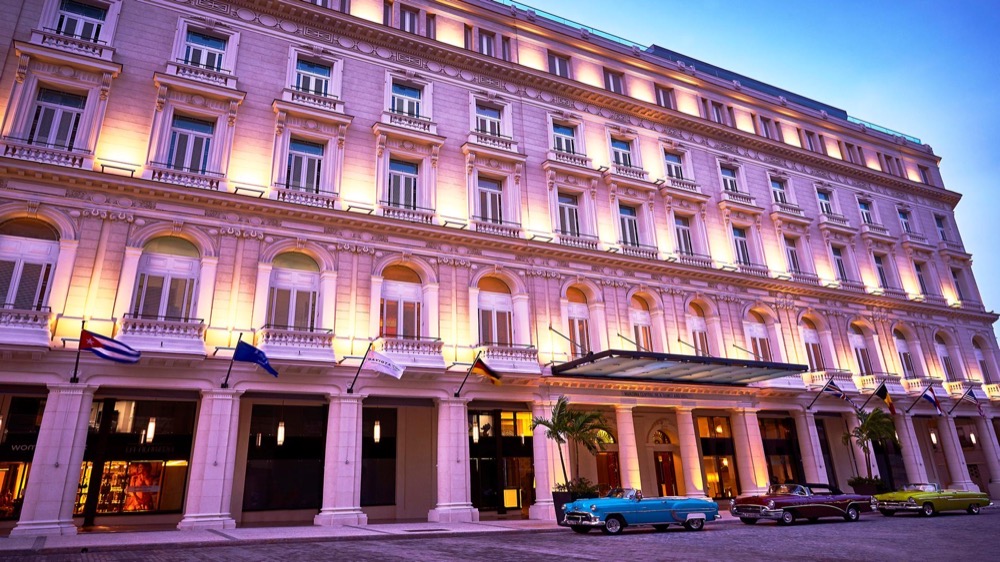
14ymedio reported on 15 June 2026 that the building, which opened in 2017 as Cuba’s first high-standard hotel and faces the Capitolio across Parque Central, was taking no bookings until at least 1 August, and that Kempinski was saying nothing. Two and a half months later, silence and a redirect. Draw your own conclusion; we won’t state one that the chain hasn’t.
One more check takes ten seconds and settles most arguments: meliacuba.com, the domain that carried thirty-six years of Cuban inventory, no longer resolves in DNS. Not the apex, not www, not the media subdomain that served the hotel fact sheets. Checked 28 August 2026.
What does the US Prohibited Accommodations List say, and when was it last updated?
The US State Department’s Cuba Prohibited Accommodations List names properties where the Cuban Assets Control Regulations generally bar persons subject to US jurisdiction from lodging or paying for lodging. Its own header reads “As of July 14, 2025”. Counted on 28 August 2026, it holds 414 property entries across 15 provinces, 94 of them in Havana and 100 in Matanzas.
Most entries were listed effective 28 September 2020, with later additions marked individually, and each carries a street address as well as a name. The names are the interesting part. The list still identifies Cuban hotels as Gran Hotel Manzana Kempinski, Iberostar Grand Packard, Iberostar Parque Central, Melia Cohiba, Melia Habana, Royalton Hicacos, Habana Riviera By Iberostar. Every one of those brands has since stopped operating in Cuba, and several of those buildings now trade under different names.
So the most authoritative English-language document about Cuban hotels is, in one respect, a photograph of a brand map that no longer exists. That is a statement about names, not about legal effect. Anyone subject to US jurisdiction should take the current published text to their own counsel; Cuba Luxury Rent gives no view on how it applies to any person or any booking, and this article is not advice on it.
How empty are Cuba’s hotels right now?
Very. Cuba received 387,591 international visitors in the first half of 2026, down 60.7% on 2025, according to ONEI figures published on 7 August 2026. June alone brought 28,100. May brought 30,883. Canadian arrivals fell 70.3%. Prime Minister Manuel Marrero told the National Assembly in late July that 73% of hotel installations were closed.
About 25,000 hotel workers are on standby pay. Occupancy across the first quarter of 2026 was 12.9%, the lowest ONEI has recorded in decades. Put those together and the exits stop looking like politics. A 400-room resort at 12.9% occupancy loses money every day it opens the doors, and a management contract on one is a liability with a brand attached.
How should you read a Cuban hotel name in 2026?
As three separate questions rather than one. Who owns the building, which is a Cuban state company and rarely changes. Who operates it this month, which changed for most of the island between May and July 2026. And which name the channel you’re booking through is using, since nine hotels were renamed in July and the older name still appears widely.
For anyone quoting a Cuban stay commercially, that means three things. Confirm the property by street address, not by brand, because the address is stable and the brand isn’t. Ask who handles a complaint before you need to make one, in writing, from whoever is selling you the room. And assume a hotel’s power and water resilience is now the building’s own problem, because no chain standard sits behind it.
That’s the part of the market Cuba Luxury Rent has spent this year on: which building is which, who answers the phone in it this week, and which private houses in Havana carry their own generator and cistern instead of borrowing the grid’s. Everything we handle is quoted on request. For most of 2026 the right answer to a Cuba enquiry has been a careful one rather than a fast one. If you want the current read on a specific property or a group in 2027, the concierge desk, general enquiries at cubaluxuryrent.com/contact/.
The signs will keep coming down for a while yet. The buildings aren’t going anywhere.
Frequently asked questions
Which hotel chains still operate in Cuba in 2026?
As of 28 August 2026, three foreign operators still market Cuban hotels on their own websites: MGM Muthu of India, with thirteen properties and a live booking engine, and the Spanish chains Blau Hotels, with three, and Roc Hotels. Melia, Iberostar, Barcelo, Blue Diamond and Kempinski no longer list any Cuban hotel.
When did Melia leave Cuba?
Melia Hotels International ended management of all its Cuban hotels on 24 July 2026, after 36 years on the island. It had already stopped managing 15 Gaviota-owned hotels in June 2026. The company blamed persistent operational, legal, economic and financial difficulties. Its Cuban booking domain, meliacuba.com, no longer resolves in DNS as of 28 August 2026.
What is Melia Cohiba called now?
Hotel Cohiba. Cubatur announced nine renamings on 28 July 2026: Melia Cohiba became Hotel Cohiba, Melia Habana became Hotel Miramar Habana, Tryp Habana Libre became Hotel Habana Libre, Iberostar Grand Packard became Hotel Packard and Iberostar Selection Parque Central became Hotel Parque Central, with four more changes in Varadero.
Are hotel bookings made before the brand change still valid?
Cubatur stated on 28 July 2026 that hotels formerly under the Melia, Iberostar, Tryp and Sol brands continue operating normally, that reservations already paid remain valid on their original conditions, and that a name or operator change does not require cancelling and rebooking. Travellers should still confirm the property by street address.
How many hotels are closed in Cuba right now?
Prime Minister Manuel Marrero told Cuba’s National Assembly in late July 2026 that 73% of the country’s hotel installations were closed, with about 25,000 workers on standby. Hotel occupancy across the first quarter of 2026 was 12.9%, and Cuba received 387,591 international visitors in the first half of the year, down 60.7% on 2025.

Join The Discussion