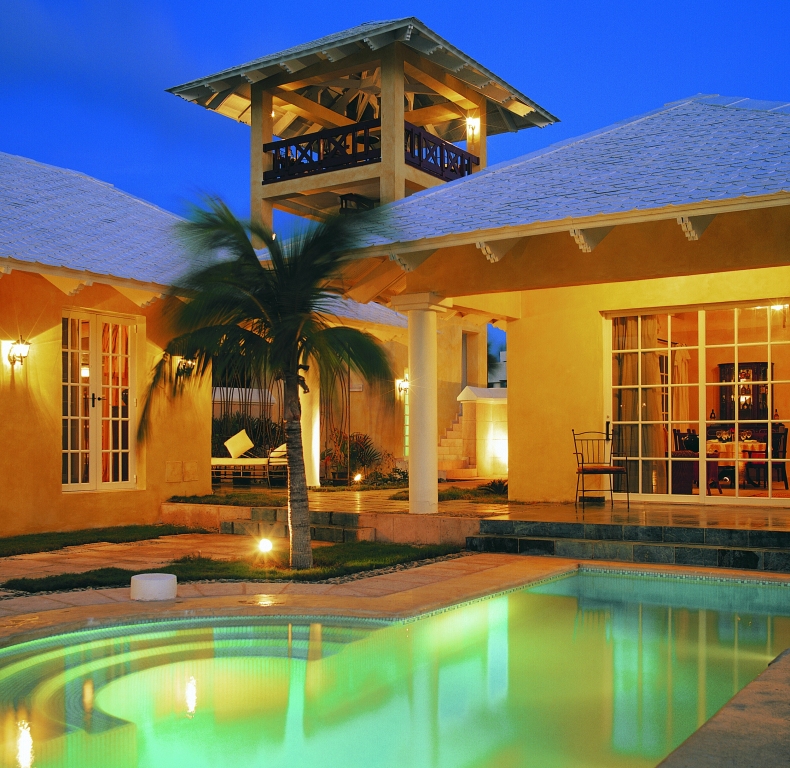
A full private villa buyout Havana means exclusive use of an entire house – every bedroom, the pool, the roof, the kitchen – with no other guests and no shared areas. It normally includes staff, a generator with fuel, stored water, and a local contact who solves problems. Cuba Luxury Rent arranges buyouts on that basis.
There’s a moment in every Havana villa handover that tells you what kind of week you’re about to have. It happens at the generator. The housekeeper walks you round the back, points at the switch, and tells you how many hours of diesel are in the tank. Either she says a number, or she doesn’t. That’s the audit. Ninety seconds, and you know.
Everything else – the mahogany doors, the sea view, the tiles somebody’s grandmother chose in 1948 – is real and it matters. But in Cuba in 2026, a villa is an infrastructure question wearing a beautiful dress. This piece is about the infrastructure, because that’s the part nobody puts in the listing.
What does “buyout” mean when you rent a villa in Havana?
A buyout is exclusive use of the whole property for your dates. Nobody else checks in, no rooms are sold separately, and the pool, terrace, kitchen and roof belong to your group alone. This is worth spelling out in Cuba, because most licensed private accommodation on the island is rented, taxed and inspected room by room rather than house by house.
That’s the structural quirk. A six-bedroom house in Vedado may exist, legally, as six rentable rooms under one licence-holder. Booking four of them doesn’t give you the house; it gives you four rooms in a house where two strangers eat breakfast at the same table as your group. The buyout is the commercial act of taking all of it, plus the shared space, plus the right to say who walks through the gate.
So a rule that has saved a lot of people a lot of disappointment: if the confirmation doesn’t use the words whole property and exclusive use, assume you haven’t got them. Ask for it in the booking text, not in a WhatsApp message that scrolls away.
Why are private villas the working option in Cuba right now?
Because most of the hotel stock isn’t operating. On 29 July 2026, Prime Minister Manuel Marrero told Cuba’s National Assembly that 73% of hotel facilities remain closed, that seven international chains had left, and that those chains managed 46% of the rooms run under that model – leaving roughly 25,000 hotel jobs in limbo. Private houses kept running.
The demand side is just as stark. Cuba’s National Office of Statistics and Information (ONEI) recorded 387,591 international visitors between January and June 2026, against 985,606 in the same period of 2025 – a fall of 60.7%, or 598,015 people. Canada, the largest market, went from 428,118 to 126,937. March 2026 was the sharpest month in the ONEI quarterly series: 35,561 visitors against 198,225 a year earlier, down 82.1%.
Now put those two facts next to each other, because the conclusion isn’t obvious. Occupancy across Cuban tourist facilities averaged 12.9% in the first quarter of 2026, against 23.7% in the first quarter of 2025. A 400-room resort at 12.9% occupancy is a machine for losing money – you still light the lobby, run the kitchen, staff the desk. A six-bedroom house with three staff and a generator has almost no fixed cost when it’s empty and a very low one when it’s full. That asymmetry is the entire reason the private house survived a collapse that closed three quarters of the hotels.
One note on the occupancy number, because sources disagree and you should know which one we trust. The 12.9% figure comes from ONEI’s quarterly tourism publication covering January to March 2026. Cubanet (30 June 2026) and Directorio Cubano (1 July 2026) both read it as Q1 2026 against Q1 2025. CiberCuba (7 August 2026) presented the same 12.9% as a May 2026 figure compared with March 2025. We use the quarterly reading, because that’s the period the ONEI publication actually covers.
How does a Private Villa Buyout Havana keep the lights on?
With a generator, and with an address that helps. On 12 August 2026, Cuba’s Union Electrica forecast 1,053 MW available against 3,250 MW of peak demand – a shortfall of 2,197 MW, with 2,227 MW of service cut at the evening peak. That is roughly two thirds of national demand going dark in the same hour, on an ordinary Wednesday.
Which makes generator specifications the least glamorous and most useful thing on a villa’s fact sheet. Three questions do most of the work.
- What does it actually carry? A small unit that runs lights, fans, the fridge, the water pump and the wifi router is a different machine from one that runs air conditioning in six bedrooms. Both are legitimate. They are not the same holiday in August.
- How many hours of fuel, and who buys the next tank? Diesel supply is the binding constraint in Cuba, not generator capacity. A house with a 30 kVA unit and no fuel line is a house with no power.
- Does it start by itself? Automatic transfer switches exist in the better properties. In the rest, somebody walks out and starts it – which is fine at eight in the evening and less fine at three in the morning if nobody sleeps on site.
Then there’s the part you can’t buy: the circuit. Some blocks in Vedado and Miramar sit on distribution circuits that also carry hospitals, embassies or state facilities, and those blocks lose power less often and for shorter stretches. Nobody publishes a map of this. You learn it from people who live on those streets and have watched which windows stay lit. It’s one of the few pieces of Havana knowledge that can’t be researched from outside the country.
Where does the water come from during a blackout?
From the villa’s own storage, because the public network runs on electric pumping. On 28 July 2026, Cubanet reported that Antonio Rodriguez Rodriguez, president of the National Institute of Hydraulic Resources (INRH), said on the state programme Mesa Redonda that more than 500 pumping stations were out of service simultaneously for lack of electricity, affecting more than 2.7 million people – close to a third of the population.
The domestic architecture that answers this is standard across Havana and worth understanding before you arrive. Water enters a cistern at ground or basement level. A small electric pump lifts it to a tank on the roof. Gravity does the rest. Cut the power and the water sits downstairs, one floor below where it’s useful, which is why the single most valuable wire in the house is the one connecting that pump to the generator.
The trend line matters too. In April 2026, 14ymedio reported around 200,000 people affected in Havana – about 11% of the capital – with 40% of service interruptions caused by faulty pumping equipment and 39% by blackouts. By late July the national figure had multiplied. Tanker trucks, the pipas, are the fallback, and they run on the same diesel everything else is queuing for.
So: cistern capacity, roof tank capacity, pump on the generator, yes or no. Three numbers. Any owner who can’t produce them hasn’t thought about their own house.
What staff comes with a full villa buyout in Havana?
Usually a housekeeper, a cook and a night presence, with a driver, a butler or security added on request. Staff is what converts a house into a stay in a country where almost nothing books online, deliveries are unreliable and a supermarket run can take three hours. The cook is normally the highest-value person in the building.
That last sentence isn’t sentiment, it’s logistics. In Havana the menu is decided by what exists that morning, not by what’s printed on a card – which means the person who knows four fishmongers, a farmer in Artemisa and somebody’s cousin with lobster is the difference between a memorable table and a disappointing one. Guests who arrive with a fixed menu in mind tend to eat worse than guests who say what they like and let the cook go hunting.
The driver matters for the same reason. A car that comes with fuel already arranged is a different proposition from a car you have to feed. Ask which one you’re getting.
And ask the awkward question early: who employs the staff, what’s included in the booking, and what is customarily settled at the end. There is nothing wrong with either arrangement. There is a lot wrong with a guest discovering the answer on the last morning, at the door, with the taxi running.
What does Cuban law require when foreign guests stay?
Registration of the guest. Decreto 160 of 2026, published in the Gaceta Oficial on 28 July 2026 and in force from 4 August 2026, establishes that those who rent out homes, rooms and spaces must give the designated body of the Ministry of the Interior the identification details of the lessee and any companions who reside outside Cuba – foreign visitors and Cubans living abroad alike.
That obligation was reported by Directorio Cubano and Periodico Cubano, both citing the Gaceta of 28 July 2026. Both also note the same gap: as reported, the decree does not set the deadline, the format, the documents to be copied, or the channel. Complementary regulations from the responsible agencies still have to be issued.
In practice this changes very little for a guest. Any properly licensed house was already keeping a guest register; your passport details have always gone somewhere. What it changes is the standard of record-keeping the owner is now held to, which is a reason to prefer a licensed, professionally run property over an informal arrangement.
We describe what has been published. We don’t interpret it, and this isn’t legal advice – for your own situation, take it to a Cuban lawyer.
The same discipline applies to the reforms people keep asking us about. On 12 June 2026, President Miguel Diaz-Canel said on national television that Cuba would open tourism to new modalities with new actors to use the infrastructure left behind by the departing chains, and that the government was studying how to handle the real-estate side of tourism. In July, a package of economic measures went to the National Assembly covering private travel agencies, guides, car rental and hotel management. Announcements, all of them, and announced by name and date. Until the implementing rules appear in the Gaceta Oficial, that’s exactly what we’ll call them.
What should you ask before booking a villa buyout?
Six things, in writing, before money moves. Whether the booking covers the whole property with exclusive use; generator capacity and what it carries; hours of fuel and who buys more; whether the water pump is on the generator; cistern and roof-tank capacity; and who the staff are and what’s included. Everything else is decoration.
| What to ask | Why it matters | A good answer looks like |
| Whole property, exclusive use? | Cuban private accommodation is normally licensed room by room, so partial bookings are possible. | Written confirmation using the words “whole property” and “exclusive use” for the exact dates. |
| Generator: what does it carry? | Lights-and-fridge back-up and full air conditioning are different machines. | A named load list: which circuits stay live, including air conditioning yes or no. |
| Hours of fuel, and who refuels? | Diesel supply, not generator size, is the binding constraint in Cuba in 2026. | A stated autonomy in hours plus who is responsible for the next tank. |
| Is the water pump on the generator? | The public network depends on electric pumping; blackouts stop water at the cistern. | Yes, with the pump named on the generator’s load list. |
| Cistern and roof-tank capacity? | Storage volume is what your group actually consumes during a long cut. | Two figures in litres or cubic metres, not an adjective. |
| Staff: who, and what’s included? | Avoids the last-morning conversation at the door. | Named roles, hours, and what is settled at the end of the stay. |
Who is a Havana villa buyout actually right for?
Groups who would rather control their environment than be served by a large one: families travelling together, milestone birthdays, small executive teams, film and photo crews. It’s the wrong choice for anyone who wants a resort’s redundancy. A house has one generator and one cistern, and when those fail you’re relying on people rather than systems.
For corporate groups there’s a real argument here, and one real caveat. The argument: a small leadership offsite works better inside a single perimeter you control than in a half-operating hotel where the restaurant hours changed this month and the meeting room shares a generator with three hundred rooms. Twelve people, one house, one cook, one driver, a terrace to work on – that’s a manageable operation.
The caveat: connectivity. Cuban mobile data and fixed lines are unreliable enough that we won’t design a programme around a live video call from a villa terrace, and we’ll say so before you book rather than after. Plan the sessions that need bandwidth for either side of the trip. Everything that needs people in a room works beautifully.
Where Cuba Luxury Rent stands, as of August 2026
Cuba Luxury Rent has worked in Cuba since 2000 and operates from a Havana office. The most useful thing we do at the moment isn’t selling – it’s checking. Before a property goes on our list, somebody confirms it’s actually operating this month: staff still there, generator still there, owner still answering the phone. In a market where 73% of the hotel stock is shut, listings go stale fast, and a beautiful photo set is not evidence that a house is open this week.
Rates for every property are on request. If you want to know what’s genuinely available in Havana right now, and what the house you’re looking at will actually do in a blackout, talk to us through /contact/ or /concierge/.
Cuba’s tourism baseline, as of August 2026
| Indicator | Latest figure | Comparison | Source, date |
| International visitors, Jan-Jun 2026 | 387,591 | 985,606 in Jan-Jun 2025 (-60.7%) | ONEI, via OnCuba, 7 Aug 2026 |
| Canadian visitors, Jan-Jun 2026 | 126,937 | 428,118 in Jan-Jun 2025 (-70.3%) | ONEI, via OnCuba, 7 Aug 2026 |
| Occupancy, tourist facilities, Q1 2026 | 12.9% | 23.7% in Q1 2025 | ONEI quarterly, via Cubanet, 30 Jun 2026 |
| Hotel overnight stays, Q1 2026 | 1.8 million | 3.6 million in Q1 2025 (-49.5%) | ONEI quarterly, via Cubanet, 30 Jun 2026 |
| Tourism revenue, Q1 2026 | 20,079 million pesos | 34,865 million in Q1 2025 (-42.4%) | ONEI quarterly, via Cubanet, 30 Jun 2026 |
| Hotel facilities closed | 73% | 7 international chains gone, 46% of chain-managed rooms | PM Manuel Marrero, National Assembly, 29 Jul 2026 |
| Grid shortfall at peak, 12 Aug 2026 | 2,197 MW | 1,053 MW available vs 3,250 MW demand | Union Electrica, via Juventud Rebelde, 12 Aug 2026 |
| Pumping stations offline simultaneously | 500+ | 2.7 million+ people affected nationally | INRH president on Mesa Redonda, via Cubanet, 28 Jul 2026 |
| Guest registration obligation | In force 4 Aug 2026 | Decreto 160/2026, Gaceta of 28 Jul 2026 | Directorio Cubano + Periodico Cubano, Aug 2026 |
Figures current as of 13 August 2026. This article was written from Havana-based operational experience and continuous work in Cuba since 2000; every statistic above was taken from the named source on 13 August 2026.
Frequently asked questions
Does a villa buyout in Havana include staff?
In most cases yes. A standard Havana villa buyout includes a housekeeper and a cook, with a driver, butler or night security available on request. What matters is written confirmation of which roles are included, their hours, and whether anything is customarily settled directly with the staff at the end of the stay.
Will there be electricity in a Havana villa during blackouts?
Only if the villa has its own generator and fuel. Cuba’s Union Electrica forecast a 2,197 MW shortfall at peak demand on 12 August 2026. A generator is standard in properties marketed for buyouts, but capacity varies widely – ask specifically whether it carries air conditioning and the water pump.
Is running water guaranteed in a private villa in Havana?
Guaranteed by storage rather than by the network. Water reaches a ground-level cistern and is pumped to a roof tank; without power the pump stops. On 28 July 2026 the INRH reported more than 500 pumping stations offline at once. Ask for cistern and tank capacity, and whether the pump runs on the generator.
Do foreign guests staying in a private house in Cuba have to be registered?
Yes. Decreto 160 of 2026, published in the Gaceta Oficial on 28 July 2026 and in force from 4 August 2026, requires those renting homes, rooms and spaces to report the identification details of lessees and companions residing abroad to the designated Ministry of the Interior body. Complementary regulations are still pending. Check your own case with a Cuban lawyer.
Can a company hold a corporate offsite in a private villa in Havana?
Yes, and small groups work better in a house than in a partly closed hotel, because the whole day sits inside one controlled perimeter. The limitation is connectivity: Cuban data and fixed lines are unreliable enough that sessions requiring live video should be scheduled either side of the trip rather than from the villa.


Join The Discussion