A permuta in Cuba is a home swap formalised before a notary. Cuba legalised outright sales in November 2011 and left the price to the two parties. What it never freed was the valuation: the state still fixes the number every transfer is taxed on. Cuba Luxury Rent checks that number, and the title behind it, before any Havana purchase.
On Saturday mornings in the years either side of 2000, the Paseo del Prado in Havana filled up with people holding pieces of cardboard. Two bedrooms, Vedado, ground floor, needs roof work. Looking for Centro Habana, upstairs, any condition. No money changed hands in public, because for most of those decades money changing hands was the part that wasn’t allowed.
That market has moved onto phones and classified sites, and outright sales have been legal since 2011. The permuta in Cuba didn’t go away. It’s still in the housing law, still notarised, and the valuation it runs on is older than the sales market that valuation now polices.
What is a permuta in Cuba, exactly?
A notarised exchange of homes between owners. Article 69 of Ley 65, the General Housing Law of 23 December 1988, puts it plainly: swaps between natural persons who own their homes are formalised directly before a notary in the municipality where either property sits, once both are entered in the Property Registry. Two titles go in, two come out.
The part that carries the money is Article 69.2. If the owners want, they can agree a compensación — a balancing payment — and it goes into the notarial deed. Article 69.3 says that payment is made at the moment of formalisation, through payment instruments issued by the bank, under rules set by the Central Bank of Cuba. So a swap is never only a swap. It’s a swap plus a number, and the number is written down.
That’s the whole mechanism, and it’s why the permuta in Cuba survived a reform that was supposed to make it redundant. Two families with unequal flats have always been able to settle the difference in cash and call the result an exchange.
What did the 2011 reform actually change?
It removed the prohibition on selling. Decreto-Ley 288 of 28 October 2011 rewrote large parts of Ley 65 and came into force on 10 November 2011. Its own preamble gives the reason in the state’s words: experience with Ley 65 and the need to help solve the country’s housing problem made it advisable to eliminate prohibitions and relax limitations on acts transferring ownership of a home.

The operative line is Article 70.3 as rewritten. Transfer of ownership of a home by sale, between natural persons, is formalised directly before a notary where the property sits, at the price the parties freely agree. Full payment is made at formalisation through bank instruments. The buyer declares on oath that they don’t already own another permanent home and proves the money is sitting in a bank branch.
There was a neat administrative detail in the same decree-law that says a lot about how fast this happened. Its single transitional provision ordered every pending application for prior administrative authorisation to transfer a home to be filed away and the documents handed back. An entire permissions queue was closed on one date. We wrote up how a Cuban property sale actually closes and what the 2024 notarial law changed about it, so this piece stays on the swap.
One limit came through untouched, and it matters to anyone buying the kind of house we deal with. The decree-law’s second special provision says that for homes in zones declared of high significance for tourism under Article 109 of Ley 65, and those covered by Article 110, the existing provisions continue to apply. The liberalisation stopped at the edge of the tourist municipalities.
How does the state value a Havana home?
By counting rooms and multiplying by where you live. For tax, Article 203 of Ley 113 Del Sistema Tributario, of 23 July 2012, uses the valor actualizado of a home — the updated value, as determined by the authority empowered to determine it. Not a valuer you hire. Not the price on the street.
Resolución 313/2024 of the Ministry of Finance and Prices, signed on 27 September 2024 and in force since 15 November 2024, puts numbers behind it. It sets minimum reference values for the personal income tax and the transfer tax on sales and donations of homes between natural persons who aren’t related to the fourth degree of consanguinity, and it repealed the 2017 resolution that had done the same job since March of that year.
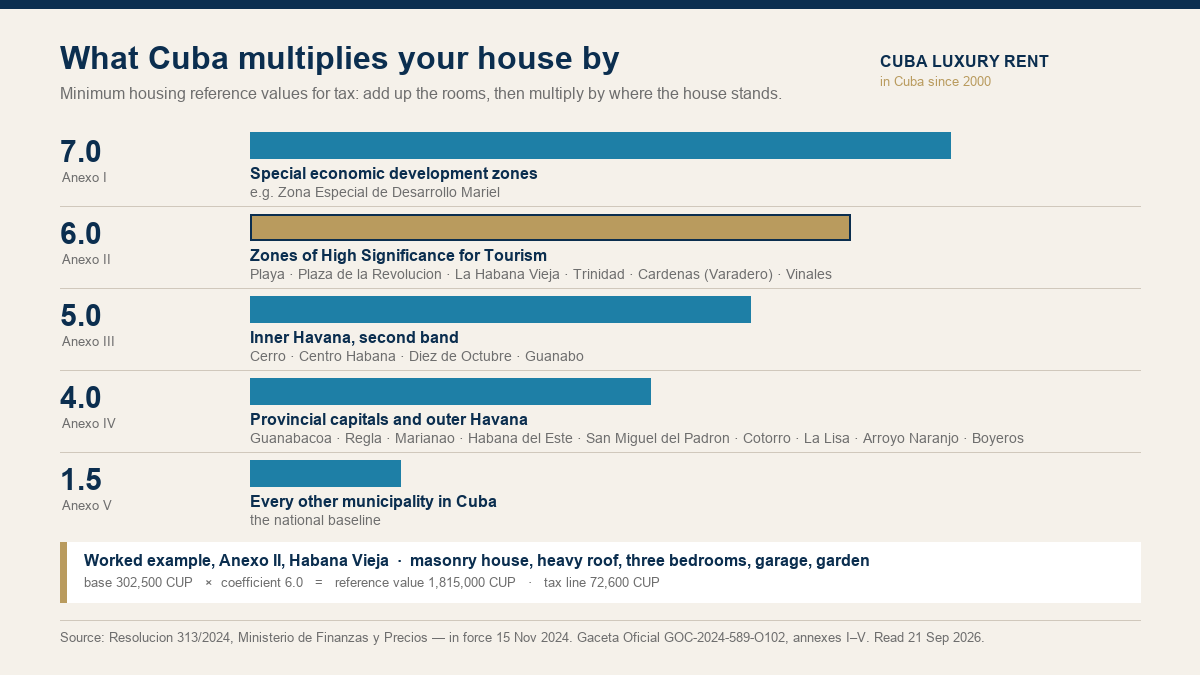
The arithmetic is public and almost startlingly simple. Each bedroom in a masonry house with a heavy roof counts 90,000 pesos. A garage or a parking space adds 15,000. A patio and gardens add 17,500. You total them and multiply by a location coefficient, and the gazette that carries the tables prints the resulting figure and the tax on it, line by line, so a family can work it out at the kitchen table without a lawyer.
Five coefficients, five annexes. Special economic development zones sit at 7.0. Then 6.0 for six municipalities the resolution names as a Zone of High Significance for Tourism: Playa, Plaza de la Revolución, La Habana Vieja, Trinidad, Cárdenas — that is Varadero — and Viñales. Cerro, Centro Habana, Diez de Octubre and the Guanabo strip take 5.0. Provincial capitals and the outer Havana municipalities take 4.0. Everywhere else in the country takes 1.5.
Read that list again if you know Havana. Those first six are the addresses that show up in every conversation about Cuban luxury property, and the state has effectively priced them at four times the national baseline before anyone looks at the building. Rural and mountain homes get 15 per cent taken off the resulting tax, and a municipal council can exceptionally knock up to 10 per cent off the minimum in suburban zones. We’ve gone through what a location coefficient does to a Havana address neighbourhood by neighbourhood elsewhere.
A worked example, straight from Annex II. A masonry house with a heavy roof, three bedrooms, a garage and a garden, in Habana Vieja: base 302,500 pesos, reference value 1,815,000 pesos, tax line 72,600 pesos. The identical house in a municipality that falls under Annex V runs on 1.5 instead of 6.0.
What does a permuta in Cuba cost in tax?
Four per cent, like nearly everything else — but calculated on a different base. Article 205 of Ley 113 charges the transfer tax at 4 per cent of the value acquired for transfers by notarial deed, and at 4 per cent of the valor actualizado of the home each swapper acquires in a permuta. Same rate. Different number underneath it.
Here’s the whole architecture in one place, because it’s the part people get wrong.
| The act | Who pays | Rate | What it’s calculated on |
| Sale — buyer side | The buyer, transfer tax | 4% | The declared price, but never less than the valor actualizado (Ley 113/2012, Arts. 203 and 205 a) |
| Sale — seller side | The seller, personal income tax on eventual income | 4%; 8% from the second sale in the same fiscal year | The transfer price, but never less than the valor actualizado (Arts. 42, 44 and 45) |
| Permuta | Each swapper, transfer tax | 4% | The valor actualizado of the home each one acquires (Art. 205 b) |
| Permuta with compensación | The party receiving the balancing payment | 4% | The valor actualizado plus the declared compensation (Art. 203) |
| Minimum reference value | Applies to sale and donation between unrelated parties | — | Five location bands, coefficient 7.0 down to 1.5 (Resolución 313/2024, in force 15 Nov 2024) |
| Deadline | Both taxes | — | 30 calendar days from the notarial deed (Arts. 46 and 210) |
Sources: Ley 113 “Del Sistema Tributario”, 23 July 2012; Ley 65 “Ley General de la Vivienda”, 23 December 1988, as amended by Decreto-Ley 288 of 2011; Resolución 313/2024 of the Ministry of Finance and Prices. All read from the Gaceta Oficial on 21 September 2026.
Which route costs less depends entirely on the two specific homes and the two specific numbers, and it isn’t a question a blog should answer for you. It’s a question for a Cuban lawyer and the tax office. What we can say is that the state’s valuation sits underneath every line in that table. Free price, fixed floor.
The ministry has been unusually direct about why the floor exists. In its own note on the reference values, published on 1 November 2024, it describes them as complementary, a containment measure against potential under-declaration. Translated out of ministry Spanish: people write down a smaller number than the one they actually agree. Everybody involved knows it. The floor is the state’s answer.
Can a permuta in Cuba carry a hidden debt?
It can, and this is the single most useful thing in this article. Decreto-Ley 342 of 14 December 2016, published on 11 April 2017 and in force thirty days later, added three paragraphs to Article 70 of Ley 65 and one to Article 69. They create an obligation that travels.
Article 70.6: an owner of a home assigned by the local People’s Power body, or built entirely with a state subsidy, who sells or donates it within the first fifteen years of acquiring it, has to pay the full subsidised amount into the State Budget. Article 70.8: the next owner keeps that obligation if they sell or donate inside the same fifteen years, counted from the original acquisition. The Fifteenth Special Provision says the clock starts at the date of the Acuerdo that assigned the home or granted the subsidy.
And Article 69.5, the one that matters for swaps: an owner of such a home who has swapped it, and then decides to sell or donate the new one, carries the same obligation on the original property. Donations between relatives to the fourth degree and adjudication on death are excepted.
Sit with that for a second. The debt attaches to a person, survives an exchange, transfers to whoever buys next, and runs off a date written on a municipal resolution that the current seller may not even possess. A house can look immaculate on its title and still be four years short of the end of somebody else’s fifteen-year clock.
That’s the real reason a permuta in Cuba is worth understanding even if you never do one yourself. So here’s my opinion, after twenty-five years of watching these deals. In Havana, the document that matters most isn’t the one they hand you. It’s the one before it.
What should a diaspora buyer check before signing?
The chain, not the photograph. Ask how the current owner got the property, and keep asking backwards until you reach either a purchase or an inheritance. If the answer anywhere in that chain is an assignment by the local government or a state subsidy, find the date of the Acuerdo and count fifteen years from it.
Then check the registration. Both Article 69 and Article 70 make prior entry in the Property Registry a condition of formalising anything, which means an unregistered title isn’t a discount — it’s a delay you haven’t priced yet. Check who lives there, too. Article 70.5 has the notary record the seller’s responsibility toward the people living in the home, and leaving a resident unprotected is listed as a ground for annulling the act, alongside the grounds in the Civil Code.
Last, check the municipality against the coefficient table before you form any view on what the paperwork will cost. A Habana Vieja address and a Boyeros address are two different tax animals, and the difference is printed in an annex.
Why does a permuta in Cuba still happen in 2026?
Because it never stopped being the native grammar of Cuban housing. Fifteen years of legal sales haven’t displaced a practice that ran for decades before them, and the state has kept legislating on it — the swap article of the housing law was amended as recently as December 2016. A permuta in Cuba is still how a family with the wrong flat in the right neighbourhood trades with a family in the opposite position.
There’s a cultural fact underneath the legal one, and it survives every reform. Cubans think about housing in terms of matching, not buying. Three-way and four-way chains are normal. Somebody in Vedado wants Miramar, somebody in Miramar wants two smaller places for two generations, and a fifth party appears to make the geometry work. The compensación is the grease.
For anyone buying from abroad, that history is the reason the paperwork looks the way it does. Havana titles often have more previous acts behind them than a comparable European house, and more of those acts are exchanges. None of which is a warning. It’s a research task, and it’s one Cuba Luxury Rent does as a matter of course before a property goes onto the Havana and Varadero houses we list for sale.
Cuba Luxury Rent has worked in Cuba since 2000, from Havana, and the single most common thing we do for a buyer isn’t finding the house. It’s reading the history of a house somebody already found. If you’re looking at a Havana property and the title has a permuta in it, send us the chain and we’ll tell you what to ask for next.
Frequently asked questions
Is a permuta still legal in Cuba in 2026?
Yes. Article 69 of Ley 65, the General Housing Law of 23 December 1988, still governs swaps between owners, and it was amended as recently as Decreto-Ley 342 of 14 December 2016. Swaps are formalised before a notary in the municipality where either home sits, after both are entered in the Property Registry.
What is the valor actualizado of a Cuban home?
The updated value determined by the authority empowered to determine it, under Article 203 of Ley 113 of 23 July 2012. It is the tax base for a swap, and the floor under the tax base for a sale: if the declared price is lower than the valor actualizado, the tax is calculated on the valor actualizado instead.
How much tax does a home swap pay in Cuba?
Article 205 b of Ley 113 sets the transfer tax at 4 per cent of the valor actualizado of the home each swapper acquires. Where the parties recognise a balancing payment, Article 203 adds that compensation to the base for whoever receives it. Payment falls due within 30 calendar days of the notarial deed.
Can a foreigner take part in a permuta in Cuba?
Article 2 of Ley 65, as rewritten by Decreto-Ley 288 of 2011, says that where the law refers to natural persons it means Cuban natural persons domiciled in the country and foreigners with permanent residence in the national territory. For most diaspora buyers the question is therefore one of domicile and residence status, and it belongs with a Cuban lawyer.
Which Cuban municipalities carry the highest housing reference values?
Resolución 313/2024 of the Ministry of Finance and Prices puts Playa, Plaza de la Revolución, La Habana Vieja, Trinidad, Cárdenas (Varadero) and Viñales on coefficient 6.0 as Zones of High Significance for Tourism. Only special economic development zones sit higher, at 7.0. The national baseline is 1.5.
Written from Havana experience, in Cuba since 2000. Legal references read directly from the Gaceta Oficial de la República de Cuba and current as of September 2026. This is market information, not legal advice — on any specific property, title or tax question, take it to a Cuban lawyer.




Join The Discussion