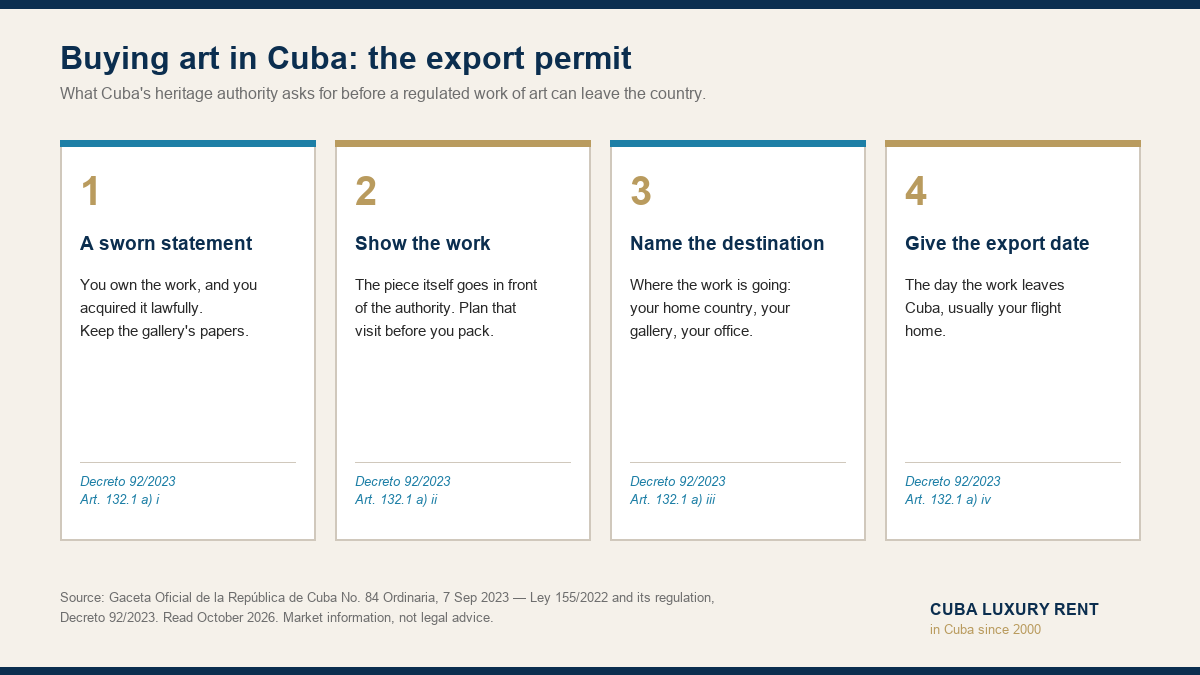
Buying art in Cuba is legal, and so is taking it home, with one condition: works regulated by Cuba’s heritage law leave the country only with an export permit. Under Ley 155/2022 and its regulation, Decreto 92/2023, the permit asks for four things: a sworn statement of lawful ownership, the work itself, its destination and the export date.
It usually happens at the end of the afternoon. The studio is on the second floor of a Vedado house, the canvases lean against the wall in threes, and somebody has made coffee. You’ve picked the piece. Then comes the question every first-time collector asks: can I actually take this on the plane?
Yes. But the answer has a procedure attached, and the procedure changed when Cuba replaced its 1977 heritage laws. Most English-language guides still describe the old system, with an old registry and fees in a currency Cuba no longer uses. Cuba Luxury Rent has watched collectors buy in Havana since 2000, and this is the rulebook as it reads in the Gaceta Oficial in October 2026.
Is buying art in Cuba legal for a foreign visitor?
Yes. Decreto 92/2023, Article 114, gives private persons free disposal of the movable cultural goods they own, with one exception: works declared Patrimonio Cultural de la Nación can never be exported for good. Buying a painting from a living artist is a private sale. Getting it out of the country is the regulated part.
Two texts carry the rules. Ley 155 of 2022, the general law on protecting cultural and natural heritage, was approved by the National Assembly on 16 May 2022. Its regulation, Decreto 92 of 2023, sits in the same issue of the gazette: Gaceta Oficial No. 84 of 7 September 2023. Both took effect 180 days after publication, in March 2024, and Ley 155 repealed the two heritage laws of 1977.
That date matters more than it looks. A dealer or a guide who learned the trade before 2024 may still talk about the old process. The authority named in the new law is the National Council of Cultural Heritage, the Consejo Nacional de Patrimonio Cultural, and its territorial structures in the provinces.
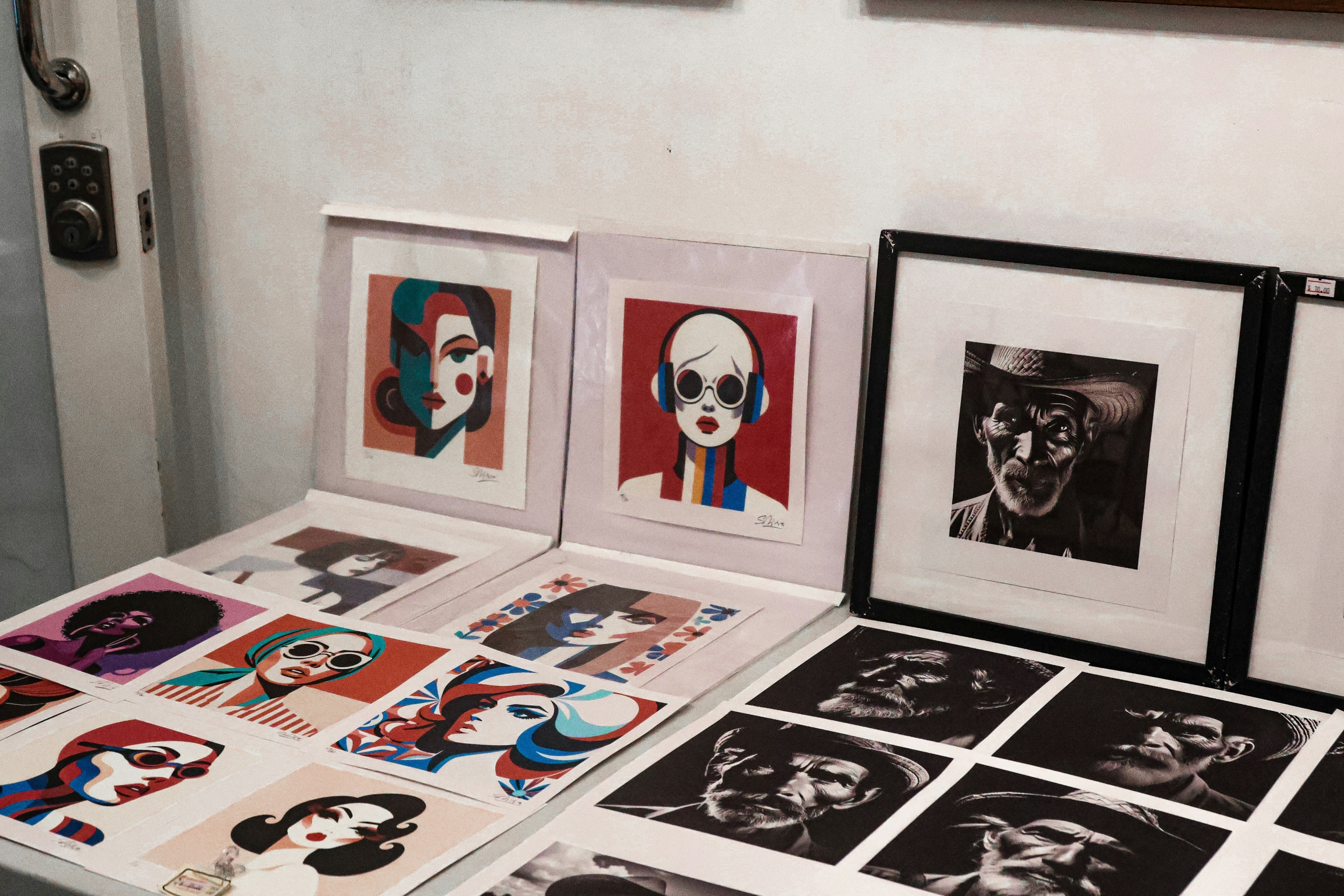
In practice, buying art in Cuba happens in three kinds of room: the artist’s own studio, a gallery, and the open-air craft and art fairs. The export article in Decreto 92 is written about the permit, not about the shop. Whichever room the work came from, the request for the permit asks the same four questions.
Which works need an export permit from Cuba?
Original works of the visual and decorative arts, applied arts and folk art are on the list. Article 22.1 of Ley 155 names ten groups of movable cultural goods, and Article 22.2 says their import and export need authorisation from the National Council of Cultural Heritage or its territorial structures, except where the Council exempts them.
The ten groups run wider than people expect: documents, books and publications, historical and ethnographic objects, natural-history specimens, archaeological finds, pieces taken from buildings, works of artistic interest, coins and stamps, musical instruments and players, and anything else the Council adds. Group (g) is the one a collector meets: “the original objects of the visual and decorative arts”.
Not every canvas is caught. Article 90 of Ley 155 says the Council periodically updates the list of works that need authorisation, and Article 131 of Decreto 92 lists what it weighs: the type of object, its age, its singularity, its level of protection, the technical capacity of the office issuing the permit, and rules set by other bodies. In short, the list moves. Ask before you assume.
What does the export permit ask for, and who issues it?
Four things, set out in Decreto 92/2023, Article 132.1 (a): a sworn statement that you own the work and acquired it lawfully, the work itself shown to the authority, the destination of the export, and the date it leaves. The permit comes from the National Council of Cultural Heritage or its territorial structures.
Article 91 of Ley 155 splits the work between them. Most collectors deal with the territorial level. The national Council keeps the cases that touch museum collections and archaeological sites, and two other ministries handle natural-heritage specimens and geological samples. For a contemporary painting bought from a studio in Havana, the request goes to the heritage authority in the city.
Here is the part people underestimate: the second requirement means the piece goes in front of the authority before it goes in your suitcase. For import, the same article only asks for images. For export, it asks to see the object. Build that visit into your week, not your last morning.
| Rule | What the text says | Where |
| Who may sell | Private owners freely dispose of their movable cultural goods | Decreto 92/2023, Art. 114 |
| What is covered | Ten groups of movable goods, incl. original works of visual and decorative arts | Ley 155/2022, Art. 22.1 (g) |
| Permit needed | Import and export need authorisation, unless the Council exempts | Ley 155/2022, Art. 22.2 |
| The list | Updated periodically by the National Council of Cultural Heritage | Ley 155/2022, Art. 90 |
| Permit requirements | Sworn statement, show the work, destination, date | Decreto 92/2023, Art. 132.1 (a) |
| No permit at the border | Customs retains the work | Ley 155/2022, Art. 92.2 |
| National heritage | Permanent export prohibited; temporary export needs all-risk insurance | Ley 155/2022, Arts. 93.2, 94.1 |
| Bringing art in | No quantity limit; apply at least 10 working days before arrival | Ley 155, Art. 92.1; Decreto 92, Art. 133.1 |
Buying art in Cuba: the export rules at a glance, as published in Gaceta Oficial No. 84 Ordinaria, 7 September 2023. Read October 2026.
What happens at the airport if the paperwork is missing?
Customs keeps the work. Article 92.2 of Ley 155 says a regulated cultural good leaving without the export authorisation is retained by the customs authorities. If the work is declared national heritage, Article 94 goes further: it’s confiscated and handed to the National Council of Cultural Heritage, which decides where it ends up.
Decreto 92 also lists exporting or attempting to export cultural goods without the permit among its contraventions, in Article 322.2. We won’t turn that into a fine table here; the amounts depend on the object and the harm, and that’s a lawyer’s reading, not ours. The practical point is simpler. An airport is the worst place to find out that a painting needed a stamp.
When is the best time for buying art in Cuba?
During the Havana Biennial, if you can plan for it. The 15th edition ran from 15 November 2024 to 28 February 2025, with 172 Cuban and 230 foreign artists listed at its opening. A 16th edition is announced for 2027 under the title Para reimaginar el Sur. As of October 2026, its dates haven’t been published.
The two counts we have from the last Biennial don’t match, and it’s worth saying why. Prensa Latina, Cuba’s state news agency, gave 172 Cuban and 230 foreign artists on opening day, 15 November 2024. At the closing on 28 February 2025, the organising committee’s president spoke of more than 1,000 artists across the central and collateral shows, more than 250 of them from 57 countries, and of more than half a million people who saw the work. The first is a programme; the second is a tally that includes everything around it. We trust the opening list for the core show.
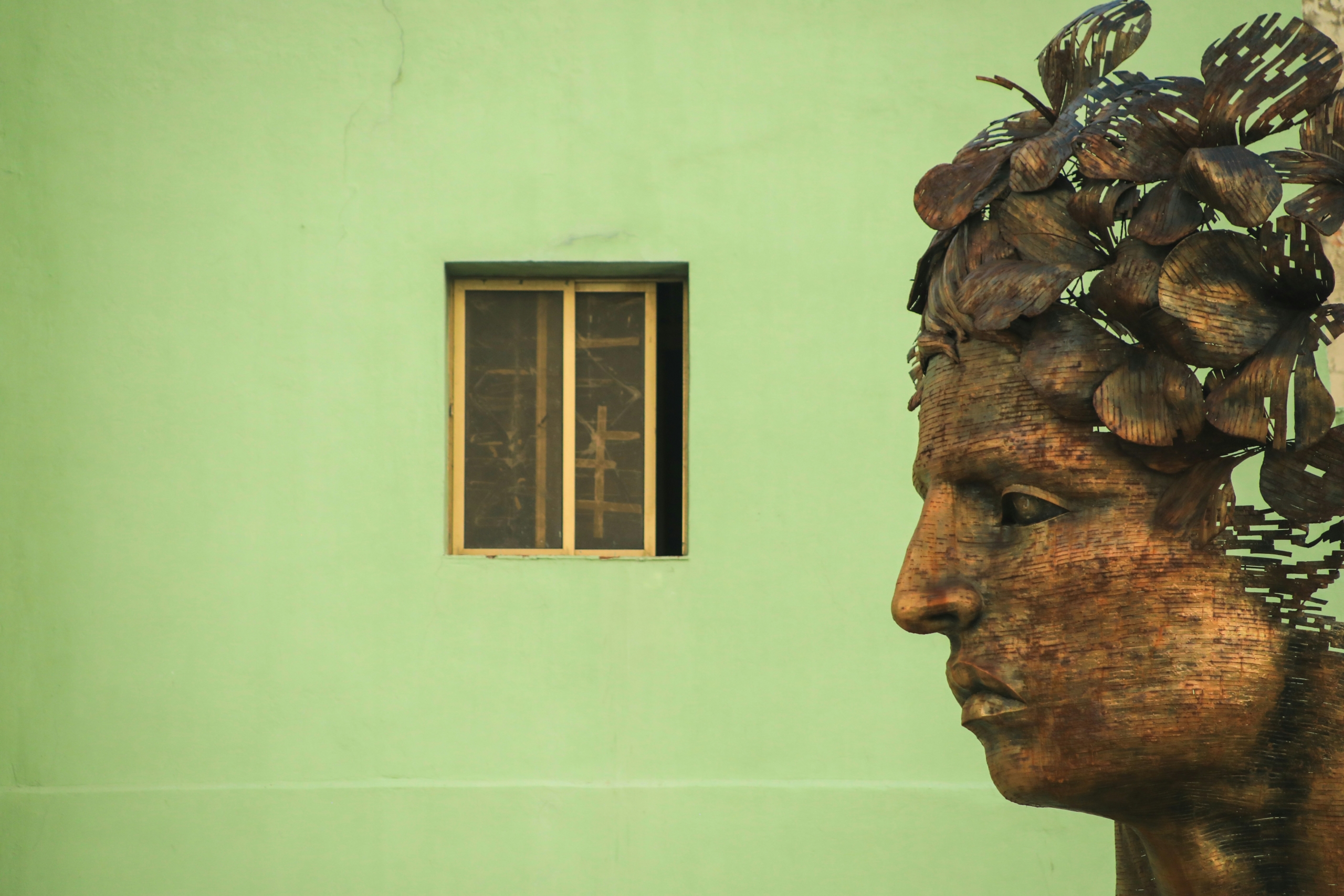
For a collector the collateral shows are the point. Studios open, artists hang work in their own houses, and the whole city behaves like one long gallery opening. Outside Biennial months, the studios are still there; you just need someone who knows which doors to knock on.
If 2027 is the plan, think in two layers. The first is the calendar: the last edition ran through the cooler months, from mid-November to the end of February, and the Wifredo Lam Center will set the new dates. The second is the house. Collectors who come for the Biennial tend to stay a week or more, receive artists at home, and want somewhere to lay a canvas flat before it’s rolled. A hotel room does that badly. A villa with a long table and a shaded terrace does it well.
One more habit worth copying from the people who do this every season. Photograph the work with the artist beside it, keep the seller’s papers in the same folder as your passport, and ask for the permit question to be answered in writing. It costs nothing, and it turns the sworn statement into a ten-minute job.
What should a collector check before buying art in Cuba?
Three things, before money changes hands: written papers from the seller that name the artist, the title, the date, the technique and the size; a straight answer on whether the piece needs an export permit; and enough days left in Cuba to show the work to the authority. The sworn statement rests on those papers.
We’d add a fourth from experience. Ask how the work will travel. A rolled canvas fits in a tube and goes in the cabin; a framed work or a sculpture becomes freight, and freight has its own timetable. Most of the disappointed buyers we’ve met over the years didn’t break a rule. They ran out of days.
Rules in the country you bring the work into are a separate matter, and this article doesn’t cover them. Neither does it cover pieces older than a few decades or antiques from family houses, where the Council’s list is far more likely to apply and a heritage declaration may already exist.
How does Cuba Luxury Rent help with buying art in Cuba?
Cuba Luxury Rent arranges the Havana side of an art week: a private villa or penthouse as a base, a driver for the studio rounds, and a cultural guide who knows the city’s artists by name. The permit application itself is yours to sign, because the sworn statement is a personal declaration of ownership.
Our concierge in Havana already books cultural guides and “Havana explained by an architect”; an afternoon in three studios is the same kind of day. If you want to know what else a concierge can open, we wrote about it in what a private concierge in Cuba can actually open. And for the base itself, the homes we list for rent sit in Vedado, Miramar and Varadero.
Tell us roughly when you’re thinking of coming, whether the 2027 Biennial is on your list, and what kind of work you collect. We’ll start from there.
Frequently asked questions
Do you need a permit to take a painting out of Cuba?
If the painting falls within the goods regulated by Cuba’s National Council of Cultural Heritage, yes. Ley 155/2022, Article 22.2, requires authorisation to export movable cultural goods, original works of visual art among them, unless the Council exempts them. The Council updates the list periodically, so check each piece.
What documents does Cuba require for an art export permit?
Decreto 92/2023, Article 132.1 (a), lists four requirements: a sworn statement on ownership and lawful acquisition of the work, showing the work to the authority, the destination of the export and the date of export. The permit is issued by the National Council of Cultural Heritage or its territorial structures.
Can art declared Cuban national heritage leave the country?
Not permanently. Ley 155/2022, Article 94.1, prohibits the definitive export of a movable cultural good declared Patrimonio Cultural de la Nación. Temporary export, for an exhibition for example, needs prior written authorisation from the National Council of Cultural Heritage and all-risk insurance under Article 93.
What happens if you leave Cuba with art and no permit?
Under Ley 155/2022, Article 92.2, customs retains a regulated cultural good that a person tries to export without the export authorisation. Works declared national heritage are confiscated and handed to the National Council of Cultural Heritage (Article 94). Decreto 92/2023 also treats it as a contravention.
When is the next Havana Biennial?
The 16th Havana Biennial is announced for 2027 under the title Para reimaginar el Sur, organised by the Centro de Arte Contemporáneo Wifredo Lam. As of October 2026 its dates had not been published. The 15th edition ran from 15 November 2024 to 28 February 2025.
Written from Cuba Luxury Rent’s work in Havana since 2000. Legal references read directly from Gaceta Oficial No. 84 Ordinaria of 7 September 2023 and current as of October 2026. This is market information, not legal advice; for a specific work, it’s worth speaking to a Cuban lawyer.


Join The Discussion